When it comes to English spelling, small differences can create big confusion. One common question is whether to write “towards” or “toward.”
Many learners, writers, and even native speakers wonder which form is correct, why both exist, and when to use one over the other.
This confusion often arises because English has regional spelling variations, influenced by British and American usage.
Understanding the difference matters for professional writing, academic work, emails, and everyday communication.
Using the wrong form can make your text feel slightly off or less natural to the reader. This guide will explain the quick answer, explore the origin of the words, compare British vs American spelling, show common mistakes, and provide real-life examples.
By the end, you’ll know exactly when to use toward or towards, making your writing clear, polished, and audience-appropriate.
Towards or Toward – Quick Answer
Quick Answer: Both toward and towards mean the same thing: “in the direction of.” They are interchangeable in meaning, but usage depends on regional preference.
Examples:
- She walked toward the park.
- He moved towards the exit slowly.
The Origin of Towards or Toward
The words toward and towards come from Old English “toweard,” meaning “in the direction of.” Over time, the -s ending was added in British English, making towards common in the UK. American English retained the simpler form toward. This historical divergence explains why both forms exist today.
British English vs American English Spelling
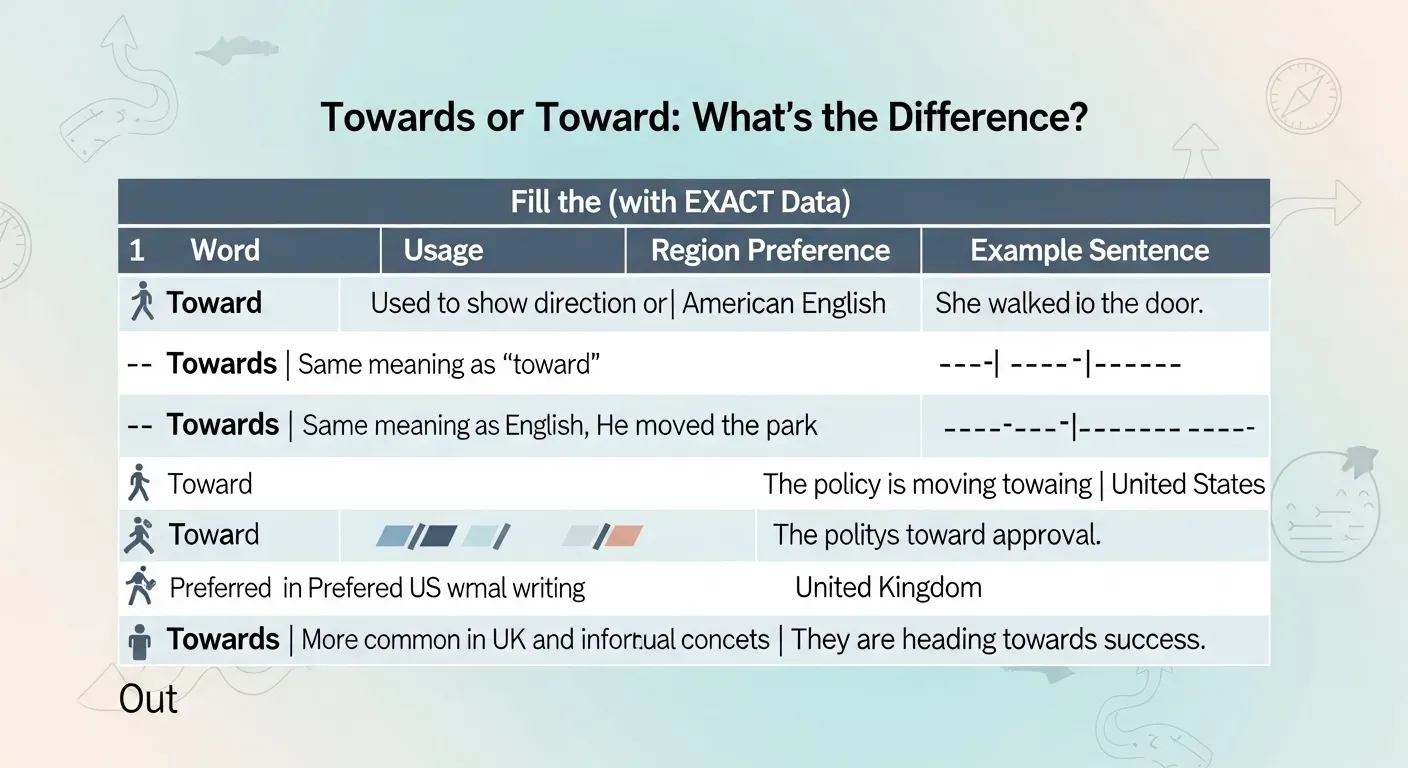
In British English, towards is preferred, while American English favors toward. Both are grammatically correct, but usage varies by region.
| Region | Preferred Spelling | Example Sentence |
| British English | towards | She ran towards the finish line. |
| American English | toward | He walked toward the door. |
| Global/Neutral | Either | Either form is usually understood. |
Tip: When writing for a global audience, either spelling works, but consistency matters.
Which Spelling Should You Use?
- Use “toward” if writing for an American audience (US-based publications, emails, reports).
- Use “towards” for British or Commonwealth readers (UK, Australia, Canada).
- Consistency: Stick to one form within a single document to maintain professionalism.
Common Mistakes with Towards or Toward
- Mixing forms in the same text:
❌ He moved toward the park, then ran towards the shop.
✅ He moved toward the park, then ran toward the shop. - Using “towards” in formal American writing:
❌ The company is moving towards innovation.
✅ The company is moving toward innovation. - Confusing with “toward’s” (incorrect possessive form):
❌ She is going toward’s success.
✅ She is going toward success.
Towards or Toward in Everyday Examples
Emails:
- Please send the files toward the end of the week.
News:
- The storm is moving towards the coast.
Social Media:
- Heading toward a new adventure!
Formal Writing:
- The research is moving toward a conclusion that benefits society.
Towards or Toward – Google Trends & Usage Data
Google Trends shows “toward” is more commonly searched in the US, while “towards” dominates searches in the UK, Australia, and India. Global searches for both forms are high, reflecting their frequent use in news, social media, and education.
Keyword Variations Comparison Table
| Variation | Usage Context | Regional Preference |
| toward | General, formal, American | US |
| towards | General, formal, British | UK, Australia, India |
| to toward | Rare, archaic | Historical usage |
| to towards | Rare, archaic | Historical usage |
FAQs
1. Can I use “toward” and “towards” interchangeably?
Yes, meaning is the same. Choose based on regional preference.
2. Is “towards” wrong in American English?
Not wrong, but it is less preferred in formal American writing.
3. Which is more common globally?
“Towards” dominates in British English countries, while “toward” is preferred in the US.
4. Do I need to use one consistently?
Yes, for clarity and professional writing, stick to one form.
5. Is “toward” formal than “towards”?
In the US, “toward” is slightly more formal; in the UK, “towards” is standard.
6. Can I use these words in social media?
Absolutely! Both are fine in casual and formal contexts.
7. Are there any other alternatives?
You can use “in the direction of” if you want to avoid regional differences.
Conclusion:
Choosing between toward and towards comes down to your audience and regional preference. Both forms are correct, mean the same thing, and are widely understood.
For American audiences, stick to toward, while British and Commonwealth readers prefer towards. Consistency within a document is key to professional writing.
Understanding these small differences helps avoid mistakes in emails, reports, social media posts, and publications.
By mastering this subtlety, you enhance clarity, maintain credibility, and communicate confidently with readers worldwide.
Next time you write, remember: pick one form, stay consistent, and your text will read naturally to any audience.

I am James Patterson, one of the world’s bestselling authors, known for fast-paced thrillers like the Alex Cross, Women’s Murder Club, and Maximum Ride series that have captivated millions of readers worldwide. I share my passion for storytelling and writing expertise with readers through my work and also feature insights on my site grammlyx.com, where great writing meets creativity.