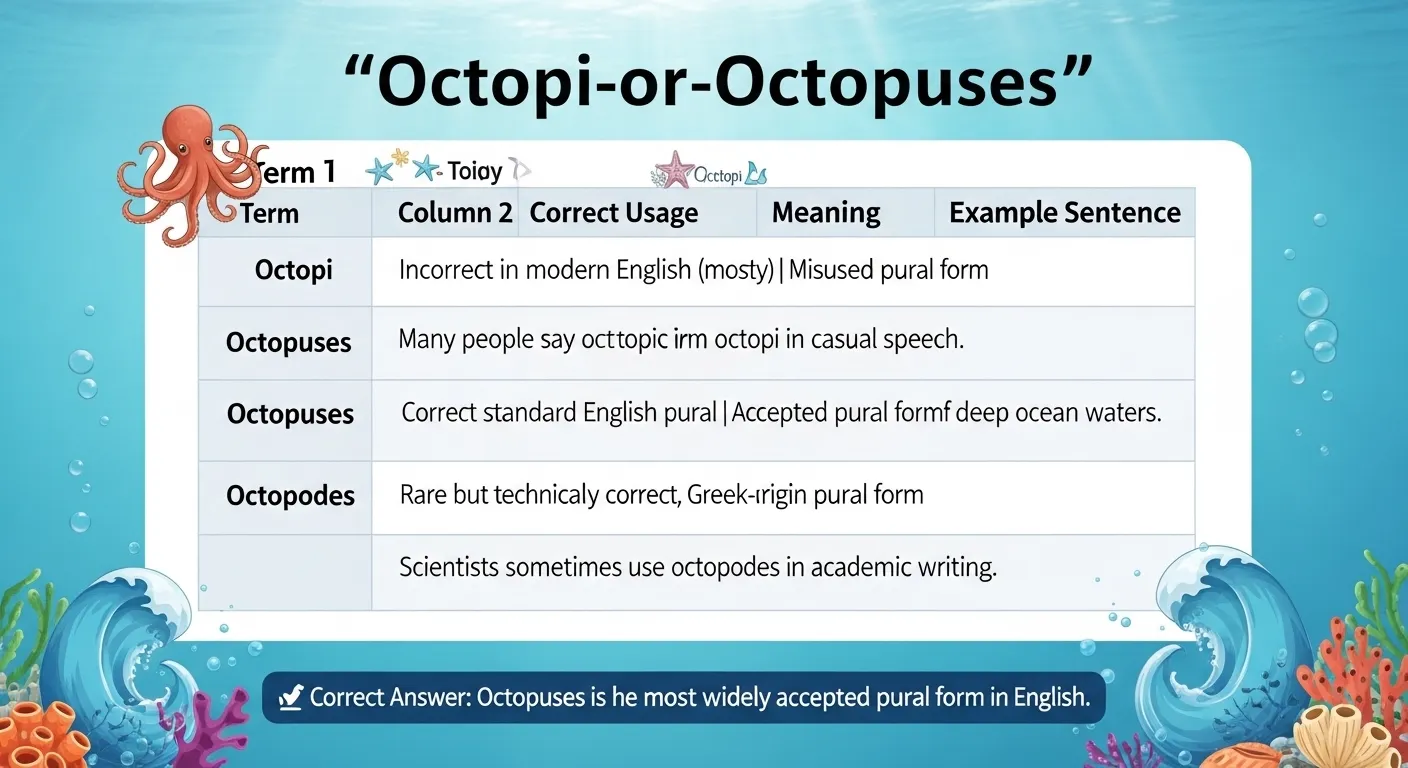
When it comes to plural forms in English, few words spark as much confusion as “octopus.” Many people wonder whether the correct plural is “octopi” or “octopuses,” and the answer isn’t as straightforward as it may seem.
This confusion often comes from the word’s origin and how English has borrowed rules from other languages over time.
“Octopus” comes from Greek, not Latin, which is an important detail. The plural “octopi” follows a Latin-style pattern, which makes it technically incorrect from a linguistic standpoint.
However, it has become widely used in casual speech, making it familiar to many English speakers. On the other hand, “octopuses” follows standard English pluralization rules, simply adding “-es” to the end of the word.
Because of this, most modern dictionaries and grammar experts consider “octopuses” the more accurate and preferred form.
There is also a third, less common option: “octopodes,” which aligns more closely with the word’s Greek roots. Despite being linguistically precise, it is rarely used in everyday conversation.
Understanding these variations helps you choose the right form depending on context, audience, and tone, making your writing clearer and more polished.
Octopi or Octopuses – Quick Answer
The quick answer is: both octopi and octopuses are correct, but octopuses is more widely accepted in modern English.
- Octopuses – Standard English plural, preferred in dictionaries.
- Octopi – Less common, influenced by Latin, not Greek origin.
Examples:
- I saw three octopuses at the aquarium yesterday.
- The chef cooked two delicious octopi for dinner.
The Origin of Octopi or Octopuses
The word “octopus” comes from Greek roots: okto (eight) + pous (foot). Because of its Greek origin, the correct English plural is octopuses, following standard English rules.
The form octopi became popular due to the mistaken assumption that “octopus” is Latin, and Latin words ending in -us often become -i in plural. Linguists consider this a historical spelling variation rather than standard grammar.
British English vs American English Spelling
Both British and American English accept octopuses, but octopi is more informal and rarely used in professional writing.
| Spelling | Region Preference | Notes |
| Octopuses | UK & US (formal) | Preferred in dictionaries, formal use |
| Octopi | US (informal) | Seen in casual writing, literature |
| Octopodes | Rare/Scientific | True Greek plural, very uncommon |
Which Spelling Should You Use?
- Use “octopuses” in formal writing, articles, and professional content.
- Octopi can appear in informal contexts or creative writing but is less standard.
- Octopodes is mostly for scientific or academic discussions.
If your audience is US-based, both octopuses and octopi are acceptable. For UK and Commonwealth readers, stick with octopuses.
Common Mistakes with Octopi or Octopuses
Many writers make these mistakes:
- Using octopi in scientific papers → should be octopuses or octopodes.
- Mixing singular/plural forms incorrectly → always use octopus (singular), octopuses (plural).
- Assuming octopi is more “correct” → actually, octopuses is preferred.
Octopi or Octopuses in Everyday Examples
- Emails: “Please review the octopuses in the marine biology report.”
- News: “Researchers discovered five new octopuses species in the Pacific Ocean.”
- Social Media: “Look at these cute octopi in the aquarium!”
- Formal Writing: “The octopuses exhibit remarkable intelligence and adaptability.”
Octopi or Octopuses – Google Trends & Usage Data
Search data shows octopuses is far more popular globally, especially in the UK, US, and Australia. Octopi spikes occasionally in casual or nostalgic writing. Scientific publications tend to prefer octopuses or octopodes.
Keyword Variations Comparison Table
| Variation | Usage Level | Notes |
| Octopuses | High | Standard, formal, dictionary-approved |
| Octopi | Medium | Informal, literary influence |
| Octopodes | Low | Scientific, rare |
FAQs About Octopi or Octopuses
1. Is “octopi” wrong?
Not wrong, but octopuses is preferred in standard English.
2. Which plural is correct in scientific writing?
Octopuses or octopodes. Avoid octopi.
3. Can I use octopi in social media posts?
Yes, it’s fine in casual contexts.
4. Why do some people use octopi?
It comes from the mistaken Latin pluralization of a Greek word.
5. Which is more popular globally?
Octopuses is far more commonly used worldwide.
6. Can octopus be both singular and plural?
No, singular is octopus, plural is octopuses.
7. Are there other forms?
Yes, octopodes is the rare, authentic Greek plural.
Conclusion:
In conclusion, both “octopi” and “octopuses” are widely recognized, but only one aligns with standard English grammar. “Octopuses” is the most accurate and recommended plural form because it follows regular English rules and is accepted by modern dictionaries.
While “octopi” is commonly used, it is based on a mistaken assumption that “octopus” has Latin origins, which it does not.
That said, language evolves through usage, and “octopi” continues to appear in casual conversations and informal writing. Because of this, it is not entirely wrong in everyday contexts, though it may be less preferred in formal or academic settings.
The rarely used “octopodes,” while closer to the original Greek roots, is mostly reserved for linguistic discussions and is unlikely to be heard in daily speech.
Ultimately, choosing the right plural depends on your audience and purpose. For clarity, correctness, and professionalism, “octopuses” is the safest option.
By understanding these subtle differences, you can communicate more effectively and confidently, even when dealing with tricky plural forms like this one.

I’m Jim Butcher, and this is my site, Grammlyx.com, where I share my work as an author. I am an expert in my craft, dedicated to delivering the best content.