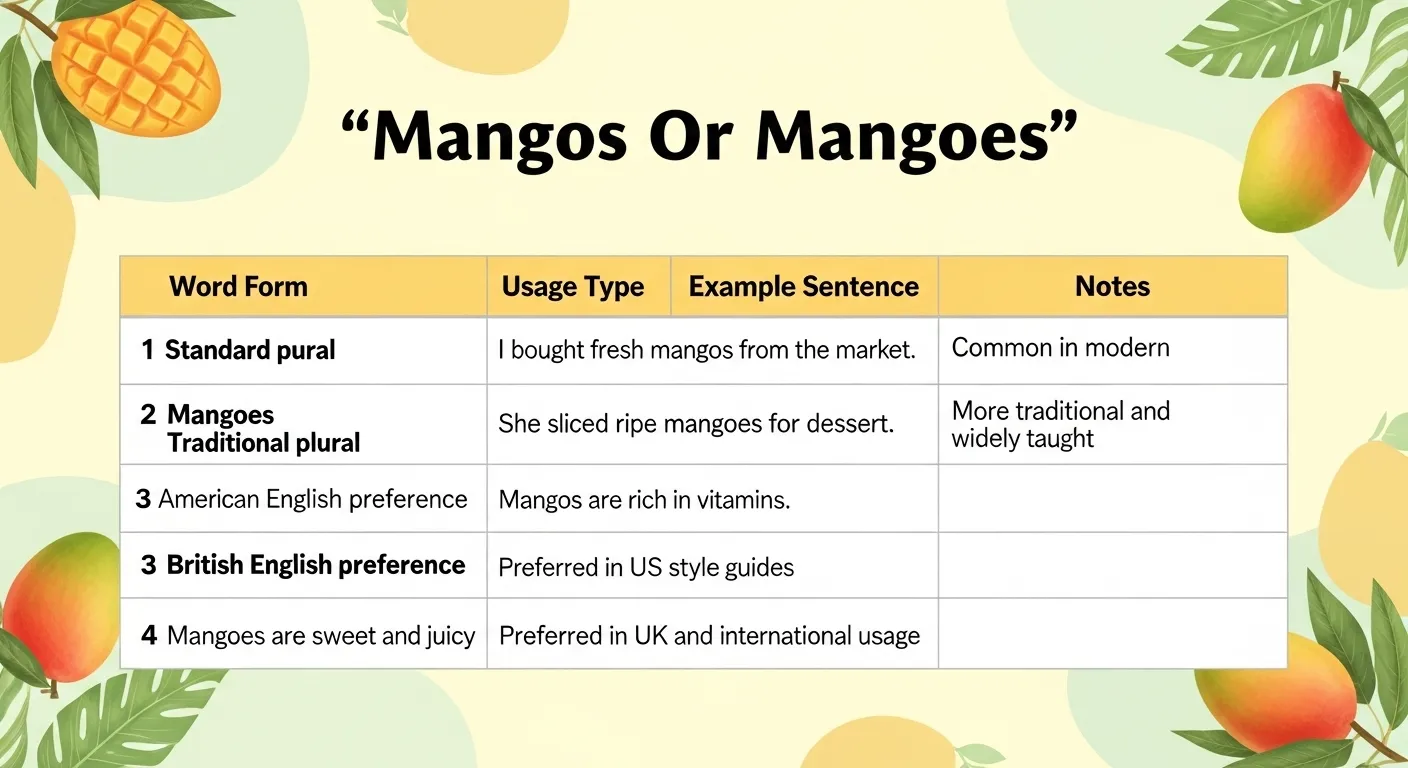
If you’ve ever paused while writing and thought, “Is it Mangos or Mangoes?”, you’re not alone. This small spelling confusion happens more often than you might expect.
People search for this keyword because English plurals can feel inconsistent, especially with words that end in “-o.”
Sometimes you see “Mangos” in menus or casual writing. Other times, “Mangoes” appears in books, articles, and formal content.
This mix creates doubt and slows down writing. That’s exactly the confusion this guide clears up.
In simple terms, both spellings exist. However, one is more widely accepted in standard English. Knowing the difference helps you write with confidence, no matter if you are creating content, sending emails, or posting on social media.
This article gives you a quick answer, clear rules, real examples, and expert advice so you never get confused again.
By the end, you’ll confidently choose the right spelling for any situation.
Mangos Or Mangoes – Quick Answer
The correct and most widely accepted plural form is Mangoes. However, Mangos is also used, especially in informal contexts.
Examples:
- I bought fresh Mangoes from the market.
- The smoothie is made with ripe Mangos.
The Origin of Mangos Or Mangoes
The word “mango” comes from the Tamil word “mankay.” It entered English through Portuguese traders in the 16th century.
English plural rules often add “-es” to words ending in “-o.” That is why “Mangoes” became the standard form.
Over time, English simplified some plurals. This led to shorter forms like “Mangos.” Both forms survived, but one stayed more formal.
British English vs American English Spelling
Both British and American English accept Mangoes as the standard spelling. However, American English sometimes uses simplified forms like Mangos.
Comparison Table
| Version | Preferred Spelling | Example Sentence |
|---|---|---|
| British English | Mangoes | She sliced fresh Mangoes. |
| American English | Mangoes/Mangos | He likes Mangoes in desserts. |
| Informal Usage | Mangos | Mango smoothies are popular. |
Which Spelling Should You Use?
Choosing between Mangos Or Mangoes depends on your audience.
- Use Mangoes in formal writing, blogs, and academic work
- Use Mangos in casual writing or marketing content
- For global audiences, Mangoes is the safest choice
If clarity and professionalism matter, always choose Mangoes.
Common Mistakes with Mangos Or Mangoes
Here are some frequent errors:
- Writing Mango’s (incorrect apostrophe)
- Mixing both forms in one article
- Using Mangos in formal documents
Corrections
- ❌ Mango’s → ✅ Mangoes
- ❌ Many Mangos in academic writing → ✅ Many Mangoes
Mangos Or Mangoes in Everyday Examples
Here’s how both forms appear in daily use:
Email:
- Please bring fresh Mangoes for the meeting.
News:
- The country exported thousands of tons of Mangoes.
Social Media:
- Loving these sweet Mangos today!
Formal Writing:
- The study focused on the cultivation of Mangoes.
Mangos Or Mangoes – Google Trends & Usage Data
Globally, Mangoes is more popular and widely searched. It appears more in:
- Educational content
- News articles
- International publications
Mangos is more common in:
- Social media
- Branding and ads
- Casual blogs
Countries like the UK, India, and Australia strongly prefer Mangoes, while the US shows mixed usage.
Comparison Table: Mangos Or Mangoes
| Feature | Mangos | Mangoes |
|---|---|---|
| Formal Writing | ❌ Not preferred | ✅ Preferred |
| Informal Writing | ✅ Acceptable | ✅ Acceptable |
| Global Usage | Limited | Widely used |
| Grammar Accuracy | Less standard | More standard |
FAQs
1. Is Mangos incorrect?
No, it is not incorrect. It is just less formal than Mangoes.
2. Why is Mangoes more common?
Because it follows traditional English plural rules for words ending in “-o.”
3. Can I use Mangos in blogs?
Yes, especially in casual or conversational content.
4. Which spelling is better for SEO?
Mangoes is better due to higher global search usage.
5. Do dictionaries accept both forms?
Yes, most dictionaries list both Mangos and Mangoes.
6. Is Mangoes used worldwide?
Yes, it is the most widely accepted form globally.
7. Should I avoid Mangos completely?
No, you can use it in informal contexts.
Conclusion:
Understanding Mangos Or Mangoes is simple once you know the rule. Both forms exist, but they are not equal in usage.
Mangoes is the standard, widely accepted, and safest choice for most writing. It fits formal, academic, and global communication. On the other hand, Mangos works in casual settings and adds a relaxed tone.
Consistency is key. Pick one form based on your audience and stick with it throughout your content. This improves clarity and builds trust with your readers.
The best approach is to use Mangoes for professionalism and Mangos for casual expression.
No matter if you are writing emails, blogs, or social posts, choosing the right form makes your writing stronger and clearer.

I’m Jim Butcher, and this is my site, Grammlyx.com, where I share my work as an author. I am an expert in my craft, dedicated to delivering the best content.