Many writers get confused between “labeled” and “labelled.” This confusion happens because both spellings are correct, yet they are used in different parts of the world.
As a result, people often search for this keyword to understand which form they should use in school, business writing, emails, or online content.
In simple terms, the difference comes from regional spelling rules in English. American English prefers one “l,” while British English uses two “l”s.
This small variation can create doubt for writers who want to maintain accuracy and professionalism.
Understanding the difference between “labeled” and “labelled” helps you write more confidently in any context.
It also ensures your content looks correct and consistent for your target audience, no matter if they are from the US, UK, or other English-speaking regions.
In this article, you will learn the meaning, origin, usage rules, and real examples of both forms. You will also discover which spelling is best for your audience and how to avoid common mistakes. By the end, the confusion around labeled or labelled will be completely clear.
Labeled or Labelled – Quick Answer
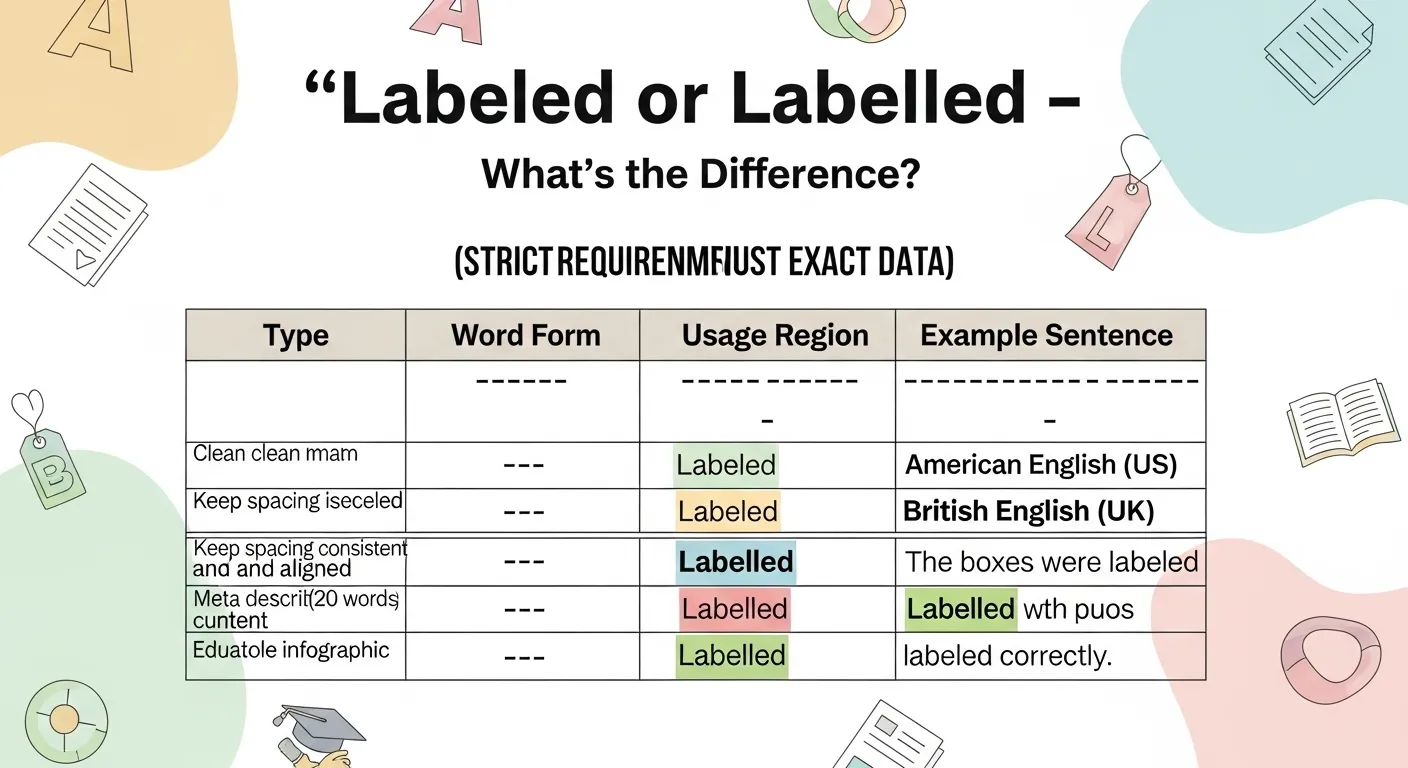
The difference between labeled and labelled is simple: both words mean the same thing, but spelling changes based on region.
- Labeled is American English.
- Labelled is British English.
Examples (Quick):
- The boxes were labeled clearly for shipping.
- The files were labelled by category in the UK office.
The Origin of Labeled or Labelled
The word comes from the Old French term label, meaning a strip of cloth or tag. Over time, English adopted it as a verb meaning “to mark or name something.”
The spelling difference developed as English evolved in different regions. American English simplified many double letters, while British English kept traditional forms.
This is why labeled vs labelled exists today as a regional variation rather than a meaning difference.
British English vs American English Spelling
English spelling rules vary between regions, especially in words with doubled consonants.
| American English | British English | Meaning |
|---|---|---|
| labeled | labelled | to mark or tag something |
| traveled | travelled | to move from place to place |
| canceled | cancelled | to call off something |
In American English, the spelling is simplified. In British English, consonants are often doubled for consistency.
Which Spelling Should You Use?
The correct choice depends on your audience.
- Use labeled for US readers, websites, or academic writing in America.
- Use labelled for UK, Canada, Australia, and other Commonwealth regions.
- Use either form in global content, but stay consistent throughout your writing.
Consistency is more important than choice. Mixing both spellings in one document can reduce clarity and professionalism.
Common Mistakes with Labeled or Labelled
Many writers make small but important errors:
- Mixing both spellings in one article
- Using British spelling for American audiences
- Forgetting consistency in formal documents
- Assuming one form is incorrect
Both “labeled” and “labelled” are correct, so the real mistake is inconsistency, not spelling choice.
Labeled or Labelled in Everyday Examples
Here’s how both forms appear in real life:
- Emails: “The documents were labeled for review.”
- News: “Boxes were labelled before distribution.”
- Social media: “Everything is labeled for easy access.”
- Formal writing: “All samples were labelled in the laboratory.”
Labeled or Labelled – Google Trends & Usage Data
Search trends show strong regional differences:
- United States: Higher usage of labeled
- United Kingdom: Higher usage of labelled
- Global English content: Mixed usage depending on audience
Digital platforms, SEO writing, and academic content often prefer American spelling for broader reach, but British spelling remains standard in many regions.
Comparison Table: Labeled vs Labelled
| Feature | Labeled (US) | Labelled (UK) |
|---|---|---|
| Spelling style | Single “l” | Double “l” |
| Usage region | USA | UK, Commonwealth |
| Formal writing | Yes | Yes |
| Meaning | Same | Same |
FAQs about Labeled or Labelled
1. Is labeled correct spelling?
Yes, it is correct in American English.
2. Is labelled wrong?
No, it is correct in British English.
3. Do both words mean the same?
Yes, both have the same meaning.
4. Which is better for SEO writing?
It depends on your target audience location.
5. Can I mix both spellings?
No, mixing reduces clarity and professionalism.
6. Why are there two spellings?
Because of historical differences in English evolution.
7. Which one is more common globally?
Both are widely used depending on region.
Conclusion:
Understanding labeled or labelled is important for clear and professional writing. Both spellings are correct, but their usage depends on regional English rules.
American English prefers labeled, while British English uses labelled. This small difference often confuses writers, but once the rule is clear, it becomes easy to apply.
The key takeaway is that meaning never changes only spelling changes based on audience and region.
To maintain strong writing quality, always choose one form and stay consistent throughout your content.
If you are writing for a global audience, consistency matters more than variation. Using the correct form builds trust, improves readability, and ensures your message is clear to readers everywhere.
In the end, both forms serve the same purpose: to describe something that is marked, named, or identified.
By applying the right version based on context, you can write with confidence and avoid common mistakes. This simple rule makes labeled or labelled easy to master in any writing situation.

I am Daniel Harper is a language enthusiast and English grammar writer with a passion for making complex language rules simple and easy to understand. With years of experience studying the nuances of the English language, Daniel has helped thousands of learners, students, and professionals improve their writing and communication skills. Through Grammlyx.com, he shares practical grammar guides, word comparisons, and writing tips designed for everyday use.