Many people get confused when they see the words Tear or Tare because they look similar but have completely different meanings.
This confusion often happens in writing, packaging, grammar tests, and everyday communication. As a result, users search for Tear or Tare to understand which spelling is correct and in what context each word should be used.
At first glance, both words may seem interchangeable, but they are not. One is related to emotion or ripping something apart, while the other is used in weighing and measurement systems. This mix-up can easily lead to mistakes in academic writing, shipping labels, or professional documents.
Understanding the difference between Tear or Tare is important for clear and correct communication.
Once you learn their meanings, you can avoid common writing errors and improve your grammar accuracy instantly.
In this article, you will learn the quick meaning, history, spelling differences, real-life usage, and common mistakes related to Tear or Tare in a simple and easy way.
Tear or Tare – Quick Answer
Tear or Tare are two different words with different meanings:
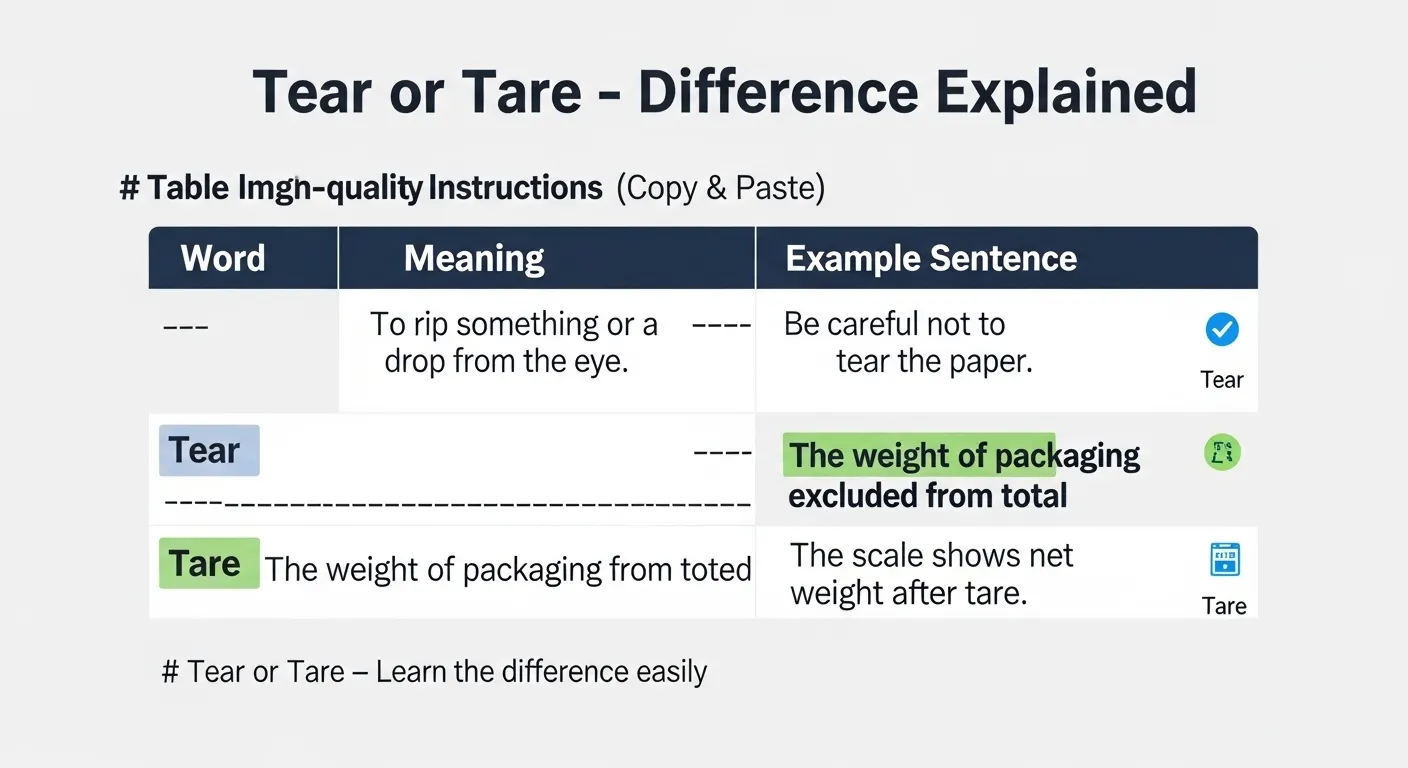
- Tear means to rip something or a drop from the eye.
- Tare means the weight of packaging that is removed during measurement.
Examples:
- She started to tear the paper into pieces.
- The machine deducted the tare weight of the box before measuring goods.
The Origin of Tear or Tare
The word Tear comes from Old English “teran,” which means to rip or destroy something physically. Over time, it also developed a second meaning related to crying.
On the other hand, Tare comes from Old French “tare,” which originally referred to impurity or defect in goods. Later, it became a technical term in trade and weighing systems.
The similarity in spelling is purely coincidental. Their meanings evolved in completely different directions, which is why confusion is common today.
British English vs American English Spelling
Both Tear or Tare are spelled the same in British and American English. The difference is not spelling but usage and context.
| Word | British English Usage | American English Usage | Meaning |
|---|---|---|---|
| Tear | Same | Same | To rip or cry |
| Tare | Same | Same | Weight deduction of packaging |
There is no regional spelling variation, only contextual difference.
Which Spelling Should You Use?
The choice depends entirely on meaning:
- Use Tear if talking about ripping, breaking, or crying.
- Use Tare if discussing weight, packaging, or measurement.
In global communication, both words are standard. However, context decides correctness, not region.
Common Mistakes with Tear or Tare
Many learners confuse these words in writing.
- ❌ Incorrect: Please tear the weight of the box.
- ✔ Correct: Please calculate the tare weight of the box.
- ❌ Incorrect: She added the tare in her eye.
- ✔ Correct: She had a tear in her eye.
Such mistakes often happen due to similar pronunciation but very different meanings.
Tear or Tare in Everyday Examples
- Emails: Please check the tare weight before final shipment.
- News: The dress began to tear during the event.
- Social media: I can’t stop my tear of happiness.
- Formal writing: The invoice includes container tare adjustment.
Tear or Tare – Google Trends & Usage Data
Search data shows that Tear or Tare is commonly searched by students, writers, and professionals.
- Tear is more popular globally due to emotional and everyday usage.
- Tare is mostly searched in logistics, trade, and science fields.
- Countries with high shipping industries show higher interest in tare weight.
This indicates that context-specific usage drives search demand.
Comparison Table: Tear vs Tare
| Feature | Tear | Tare |
|---|---|---|
| Meaning | To rip or cry | Weight deduction |
| Usage Area | Emotions, actions | Trade, logistics |
| Field | General English | Technical/industrial |
| Example | Tear paper | Tare weight |
FAQs about Tear or Tare
1. What is the main difference between Tear and Tare?
Tear means to rip or cry, while Tare refers to weight adjustment in measurement.
2. Are Tear and Tare pronounced the same?
Yes, both are often pronounced similarly, which causes confusion.
3. Can Tear and Tare be used interchangeably?
No, they have completely different meanings.
4. Where is Tare commonly used?
It is mainly used in shipping, packaging, and industrial weighing.
5. Is Tear only related to emotions?
No, it also means to rip something physically.
6. Why do people confuse Tear or Tare?
Because they look and sound similar but have unrelated meanings.
7. Which word is more common?
Tear is more common in everyday language.
Conclusion:
Understanding the difference between Tear or Tare is essential for clear and correct communication.
These words may look similar, but their meanings belong to completely different areas of English usage. Tear is linked with emotions and physical action, while Tare is strictly technical and used in measurement systems.
By learning their proper contexts, you can avoid grammar mistakes and improve your writing accuracy in both academic and professional settings.
Remember that correct word choice depends on meaning, not appearance or sound.
In daily writing, always double-check the context before using Tear or Tare to ensure clarity and professionalism. With practice, this confusion will disappear, making your English more precise and confident.

I’m Jim Butcher, and this is my site, Grammlyx.com, where I share my work as an author. I am an expert in my craft, dedicated to delivering the best content.