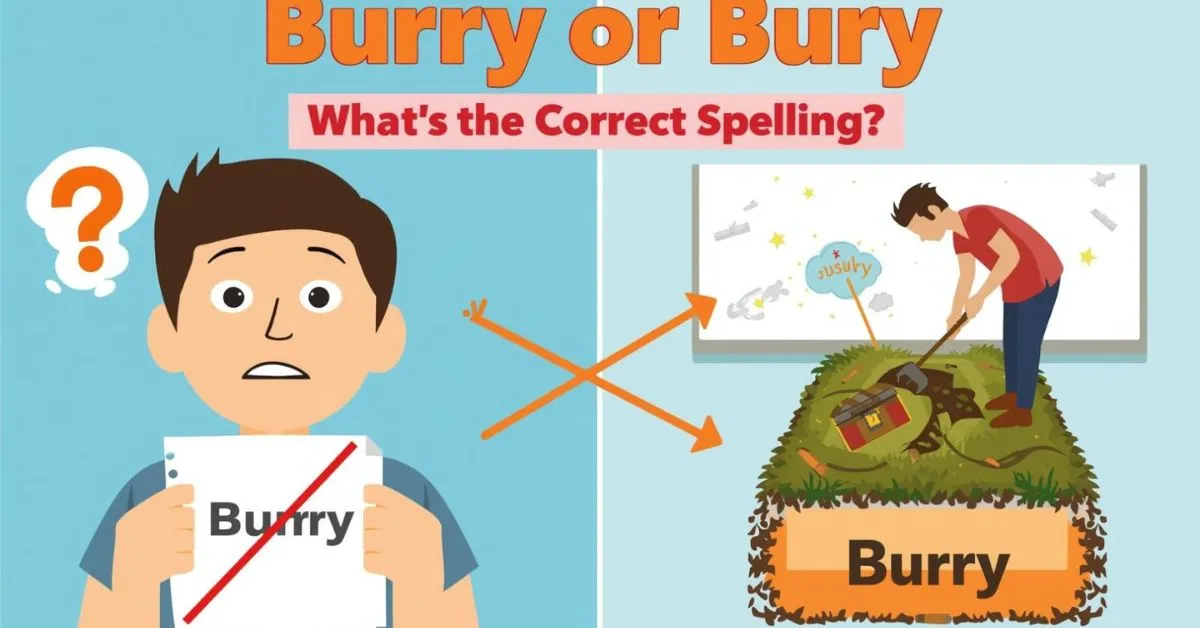
When it comes to writing correctly, small spelling differences can create big confusion. One common question people search online is “burry or bury”.
Are they interchangeable, or is one just wrong? Many English learners and even native speakers wonder why this difference exists and which spelling to use in everyday writing.
The confusion arises because “burry” and “bury” sound the same, but only one is correct in standard English. Misusing them can make your writing appear careless, especially in formal documents, emails, or academic writing.
Understanding the right choice ensures clear communication and boosts your confidence in both casual and professional contexts.
This guide will explain the correct usage, the origin of the word, spelling differences between British and American English, common mistakes, and practical examples to help you never confuse burry or bury again.
Burry or Bury – Quick Answer →
The correct spelling is “bury”.
Burry is generally considered a misspelling, except when referring to something covered in burrs (the prickly seeds of a plant).
Examples:
- Correct: I will bury the time capsule in the garden.
- Correct: She likes to avoid things that burry the fabric with burrs.
The Origin of Burry or Bury
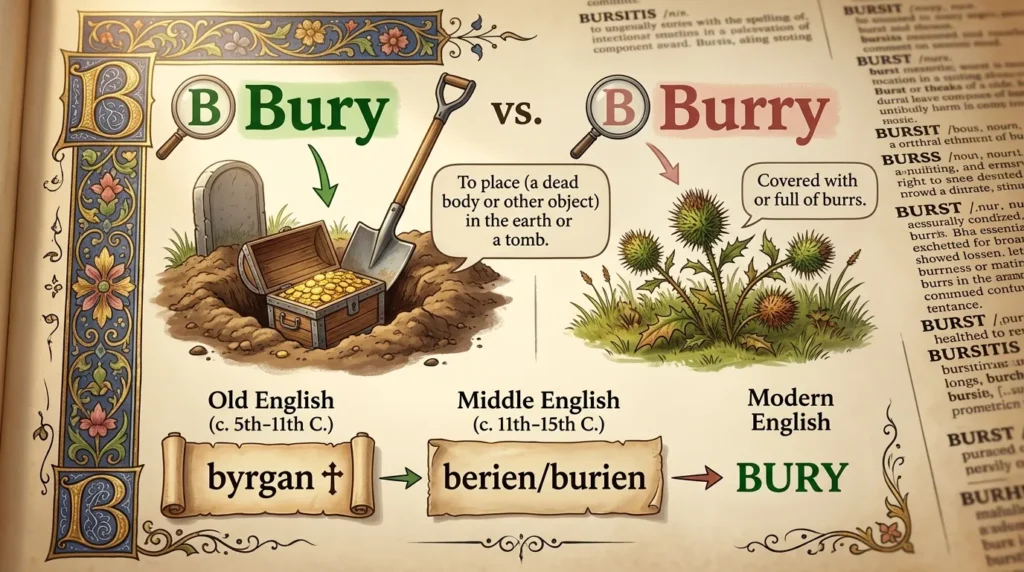
The word “bury” comes from the Old English “byrgan”, meaning “to hide or inter.” Over time, the spelling simplified to “bury” in modern English.
The misspelling “burry” likely appears because English pronunciation can be misleading: the “u” in “bury” sounds like “uh,” making people think it needs a double “r.”
The word Bury comes from Old English byrgan, which means “to place in the ground” or “to hide.” Over time, the spelling changed slightly, but the meaning stayed the same in modern English.
The spelling Burry is different and much less common. It is usually used as an adjective to describe something covered with burrs or rough seed cases. Many people confuse Burry with Bury because both words sound similar when spoken quickly. However, dictionaries recognize Bury as the correct verb for placing something underground.
British English vs American English Spelling
Both British and American English use “bury”. There is no variation between the two in this case.
| Word | British English | American English | Notes |
| Bury | ✅ Correct | ✅ Correct | Standard spelling |
| Burry | ❌ Incorrect (except for burr-related contexts) | ❌ Incorrect | Only used as adjective meaning covered with burrs |
So, whether you’re writing in the UK, US, or other English-speaking countries, bury is the standard spelling.
Which Spelling Should You Use?
- US English → Always use bury.
- UK/Commonwealth English → Always use bury.
- Global audience → Stick with bury to avoid confusion.
Use burry only when specifically talking about something with burrs, like “a burry coat.”
Common Mistakes with Burry or Bury
- Writing burry when referring to interring someone or something.
- ❌ Wrong: I will burry the letter in the box.
- ✅ Correct: I will bury the letter in the box.
- Confusing the adjective burry (covered in burrs) with the verb bury.
- ❌ Wrong: The dog found a burry in the garden.
- ✅ Correct: The dog found a burry plant in the garden.
- Mispronunciation causing incorrect spelling in emails, social media, or essays.
Burry or Bury Pronunciation: Easy Guide to Say It Correctly
The pronunciation of “burry” and “bury” often confuses English learners because the words look similar but sound slightly different. The word “bury” is pronounced like “berry” (/ˈberi/), while “burry” is pronounced as /ˈbɜːri/ or /ˈbʌri/ depending on the accent.
Correct Pronunciation of “Bury”
The word “bury” means to place something underground or hide it. Even though it is spelled with a “u,” it sounds like “berry.”
✅ Pronunciation: BEH-ree
✅ IPA: /ˈberi/
Example:
They will bury the treasure underground.
Correct Pronunciation of “Burry”
The word “burry” is an adjective used for something covered with burrs or prickly seeds. Its pronunciation follows the spelling more closely than “bury.”
✅ Pronunciation: BUR-ee
✅ IPA: /ˈbɜːri/
Example:
The dog ran through a burry field.
Quick Tip to Remember
- Bury = sounds like “berry” 🍓
- Burry = sounds like “bur-ee” 🌿
Remembering this small pronunciation difference can help improve both your speaking and spelling skills in English.
Burry or Bury in Everyday Examples
- Emails: “Please bury the old files in the archive folder.”
- News articles: “They decided to bury the time capsule near the school.”
- Social media: “We need to bury last year’s mistakes and move forward.”
- Formal writing: “The archaeologists plan to bury the artifacts safely after documentation.”
Burry or Bury the Dead: Which One Is Correct?
The correct phrase is “bury the dead.” The word “bury” is a verb that means to place a dead body in the ground during a funeral or burial ceremony.
❌ Wrong: They will burry the dead tomorrow.
✅ Correct: They will bury the dead tomorrow.
Why “Bury” Is Correct
The word “burry” is not used for funerals or placing something underground. It is an adjective that describes something covered with burrs or prickly seeds. That is why “bury the dead” is the proper and grammatically correct expression in English.
Pronunciation Tip
Even though “bury” is spelled with a “u,” it is pronounced like “berry.”
✅ Pronunciation: BEH-ree
✅ IPA: /ˈberi/
Burry or Bury – Google Trends & Usage Data
According to Google Trends, “bury” dominates searches globally, while “burry” appears mostly in the context of plants or accidental misspellings. The US, UK, Canada, and Australia show the highest searches for correct spelling.
| Keyword | Popularity | Context |
| Bury | High | Correct interring of objects or people |
| Burry | Low | Plants with burrs, misspellings |
FAQs
1. Is “burry” ever correct?
Yes, but only as an adjective meaning “covered with burrs.” For interring, use bury.
2. Can I use “burry” in formal writing?
No, always use bury for professional or academic writing.
3. Why do people confuse “burry” and “bury”?
Because of pronunciation: “bury” sounds like “burry,” leading to spelling errors.
4. Does British English use “burry”?
No, British English also uses bury for standard contexts.
5. Are there mnemonic tips to remember “bury”?
Think of a grave: “You bury someone in the ground, never ‘burry.’”
6. How do you spell the past tense?
The past tense is buried (I buried the treasure).
7. Can “burry” be used as a verb?
Rarely, only when describing covering something with burrs, not standard writing.
Comparison Table
| Variation | Usage | Correctness |
| Bury | To inter or hide something | ✅ Correct |
| Burry | Covered with burrs, occasional misspelling | ⚠️ Contextual |
Conclusion
In conclusion, when deciding between burry or bury, always remember that bury is the correct spelling for most contexts, especially for interring, hiding, or metaphorical usage. Burry is rarely correct and mostly limited to describing burr-covered objects.
Using the right form ensures clarity, professionalism, and prevents common mistakes in emails, articles, and academic writing.
Stick to bury for universal correctness, follow the examples above, and avoid letting pronunciation mislead your spelling.
If you are in the US, UK, or writing for a global audience, bury is the spelling that guarantees your message is understood and respected.

I’m Jim Butcher, and this is my site, Grammlyx.com, where I share my work as an author. I am an expert in my craft, dedicated to delivering the best content.