Many people search for Utmost or Upmost because these two words look very similar but have different meanings.
This small spelling difference often creates confusion in writing, exams, and everyday communication. If you are unsure which word to use, you are not alone. Many learners and even native speakers mix them up because both sound alike and appear in formal sentences.
The confusion usually happens when someone wants to express importance or degree. They may write “upmost respect” instead of the correct phrase “utmost respect.” This mistake can change the meaning or make the sentence look unprofessional.
That is why understanding the difference is important for clear and correct writing.
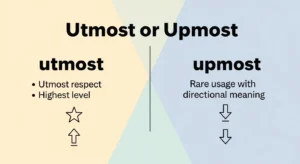
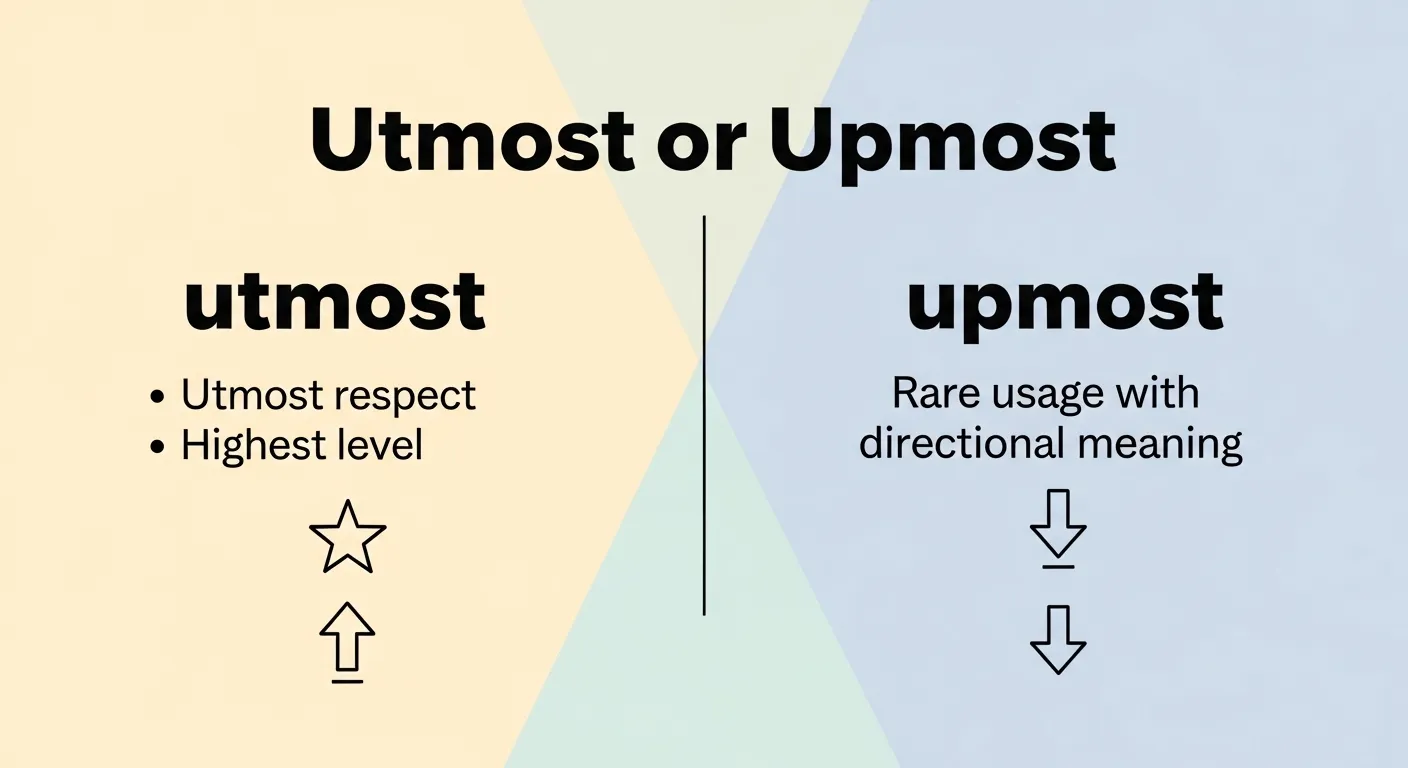
The word utmost means the highest level or greatest degree, while upmost refers to position or direction, though it is rarely used today.
Learning this simple difference helps you avoid common mistakes and improves your writing confidence quickly.
In this guide, you will learn the meanings, correct usage, and easy tips to remember Utmost or Upmost without confusion.
Utmost or Upmost – Quick Answer
Utmost means “the greatest degree or extent” and is used to emphasize importance, effort, or seriousness.
Upmost means “highest in position” and refers to a physical or figurative top level.
Examples:
- She showed the utmost respect to her mentor.
- The treasure was hidden in the upmost drawer of the cabinet.
The Origin of Utmost or Upmost
The word “utmost” comes from Middle English utmoste, meaning “farthest out” or “extreme,” derived from Old English ut (out) and mæst (most). It has long been used in English to emphasize intensity or importance.
“Upmost” emerged later as a combination of up + most, mainly used to describe height or position. Unlike “utmost,” “upmost” has a clear spatial sense.
The spelling differences exist because one word evolved to indicate extremity or degree (utmost), while the other indicates top position (upmost).
British English vs American English Spelling
Both utmost and upmost are used in British and American English, but utmost is far more common in both varieties.
| Word | British English Usage | American English Usage | Example |
| Utmost | Very common | Very common | She gave utmost attention to details. |
| Upmost | Less common | Less common | Place the vase on the upmost shelf. |
Note: Some British texts use “upmost” more than American texts, but in formal writing, utmost is almost always correct for emphasizing degree.
Which Spelling Should You Use?
- If you mean the greatest degree, importance, or effort → use Utmost.
- If you literally mean “highest in position” → use Upmost.
For global audiences, especially in formal writing, emails, or online content, utmost is the safest choice. Upmost should be reserved for physical or metaphorical top positions.
Common Mistakes with Utmost or Upmost
- ❌ She showed the upmost respect to her teacher.
✅ She showed the utmost respect to her teacher. - ❌ Put the documents in the utmost drawer.
✅ Put the documents in the upmost drawer. - ❌ Your upmost effort is needed here.
✅ Your utmost effort is needed here.
Tip: Ask yourself—are you emphasizing intensity or position? That will guide your choice.
Utmost or Upmost in Everyday Examples
- Email: “We appreciate your utmost attention to this matter.”
- News: “The rescue team acted with utmost bravery.”
- Social Media: “Feeling the utmost happiness after graduation!”
- Formal Writing: “It is of utmost importance to maintain confidentiality.”
- Physical Position: “Place the trophy on the upmost shelf for display.”
Utmost or Upmost – Google Trends & Usage Data
- “Utmost” dominates online usage globally, especially in the US, UK, Canada, and Australia.
- “Upmost” is far less frequent and mostly appears in British English literature and architectural descriptions.
- People search for this keyword mainly to avoid writing mistakes in academic, business, or professional contexts.
Comparison Table of Variations
| Variation | Meaning | Usage Frequency |
| Utmost | Greatest degree or intensity | Very High |
| Upmost | Highest in position | Low |
FAQs
1. Can I use utmost and upmost interchangeably?
No, they have different meanings. Use utmost for degree/intensity and upmost for top position.
2. Is “upmost” wrong in modern English?
Not wrong, but it is rare and mostly used for literal height. Utmost is preferred for emphasis.
3. Which is more common in emails, utmost or upmost?
Utmost is far more common in professional emails.
4. Can “utmost” describe physical position?
No, it only describes intensity or importance, not physical placement.
5. How do you remember the difference?
Think: Utmost = Ultra effort/importance; Upmost = highest Up position.
6. Is “upmost” acceptable in UK English?
Yes, but only when describing literal top position.
7. Is there a plural form for utmost or upmost?
No, both are adjectives and do not have plural forms.
Conclusion
Understanding Utmost or Upmost is simple once you focus on their meanings and usage. The word utmost is the correct and commonly used term when you want to express the highest level of importance, effort, or respect.
On the other hand, upmost relates to position or direction, and it is rarely used in modern English.
Many people make mistakes by using “upmost” in place of “utmost,” especially in formal writing. This can make sentences look incorrect or less professional.
That is why it is important to remember the key difference and apply it correctly in everyday communication.
The most important takeaway is that “utmost” should be your default choice in almost all situations.
Using the correct word improves clarity, builds trust, and makes your writing stronger and more polished.
No matter if you are writing emails, essays, or social media posts, choosing between Utmost or Upmost correctly will help you communicate with confidence and accuracy.

I am James Patterson, one of the world’s bestselling authors, known for fast-paced thrillers like the Alex Cross, Women’s Murder Club, and Maximum Ride series that have captivated millions of readers worldwide. I share my passion for storytelling and writing expertise with readers through my work and also feature insights on my site grammlyx.com, where great writing meets creativity.