Have you ever frozen mid-sentence, unsure how to finish your thought? You are probably stuck on the classic grammar trap of Than Or Then.
Millions of writers face this exact problem every single day. People search for this keyword because these two words sound almost identical when spoken out loud.
This small sound similarity creates a huge amount of confusion in emails, essays, and text messages. Readers want to know if they should use the “a” or the “e” to make their sentence correct.
This guide solves that exact puzzle by breaking down the strict rules for each word. By learning the difference between Than Or Then, you will instantly improve your writing skills.
Using the correct word shows your readers that you are careful, smart, and professional. Mastering this simple grammar rule ensures your message is always clear, no matter if you are writing to a boss or a friend.
Furthermore, choosing the right spelling prevents embarrassing errors in your daily work. Read on to discover the easy tricks that make choosing the right word very simple.
Than Or Then – Quick Answer
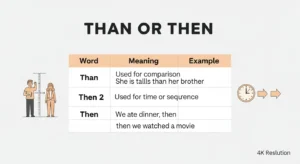
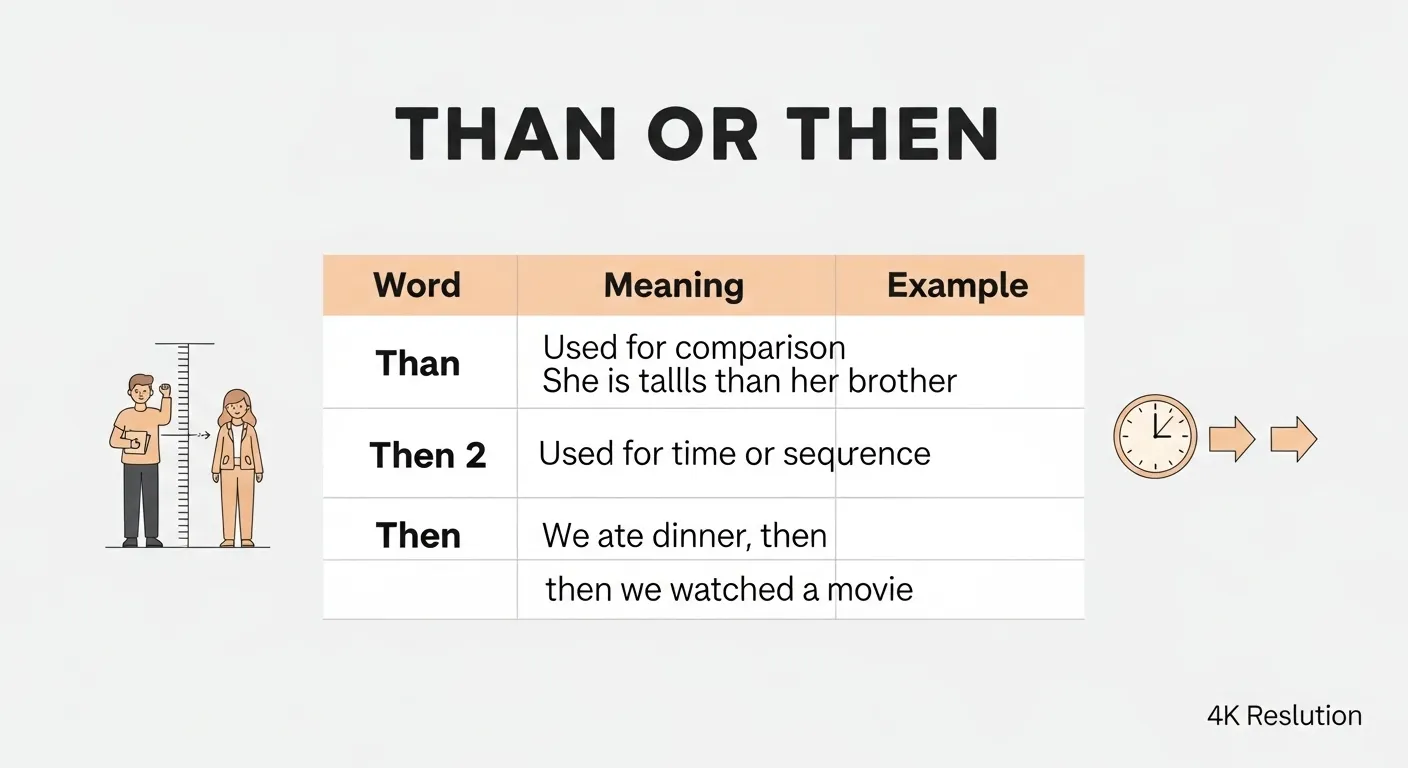
Than Or Then are two completely different words with completely different jobs. “Than” is used strictly for comparing two things.
“Then” is used to talk about time or the order of events. If you are comparing items, use “than.” If you are showing what happens next, use “then.”
- Example 1: The green apple is much sweeter than the red apple.
- Example 2: We will finish our homework, and then we can play outside.
The Origin of Than Or Then
The history of these words is very surprising to many people. Hundreds of years ago, they were actually the exact same word.
In Old English, people used “thanne” or “thenne” for both time and comparisons. Spelling differences exist now because the English language evolved over time.
Writers slowly started using the “a” spelling for comparisons to avoid confusion. Today, they are totally separate words with very strict rules.
British English vs American English Spelling
Many words change spelling depending on where you live. However, the rules for Than Or Then do not change at all.
Both British and American English follow the exact same grammar laws for these words. There is no special spelling for the UK or the US.
You must use “than” for comparing and “then” for time everywhere.
| Grammar Rule | American English | British English |
| Comparing Things | Than | Than |
| Showing Time | Then | Then |
| Spoken Sound | Very Similar | Very Similar |
Which Spelling Should You Use?
You should base your choice entirely on the meaning of your sentence. Your location does not matter at all for Than Or Then.
If you are writing for a global audience, the rules stay the exact same. Use “than” when you look at differences between two items.
Use “then” when you are listing steps or telling a story in order. This applies to all readers in every single country.
Common Mistakes with Than Or Then
The biggest mistake is typing too fast and swapping the vowels. People often write “then” when they mean “than” simply because of how it sounds.
Another frequent error is using “then” with the word “rather.” The correct phrase is always “rather than,” never “rather then.”
Always double-check your sentences if you are comparing sizes, amounts, or choices.
Than Or Then in Everyday Examples
- Emails: “Please review this document, and Than Or Then send it to the client.” (Choosing the right word here means using “then”).
- News: “The mayor stated that the city is safer today Than Or Then it was last year.” (Choosing the right word here means using “than”).
- Social Media: “I love coffee more Than Or Then tea, but I always mix up the spelling!”
- Formal Writing: “The study explores if students used the rules of Than Or Then accurately in tests.”
Than Or Then – Google Trends & Usage Data
Data shows a massive amount of searches for Than Or Then every single day. Students and professionals constantly look up these basic rules.
Countries with high English learning rates show the most searches. The confusion also peaks during major exam seasons.
People frequently search for this rule when writing important cover letters or resumes. They want to ensure their grammar is totally perfect.
Comparison Table: Keyword Variations
| Word Choice | Meaning | Best Use Case |
| Than Or Then | The grammar debate | Searching for rules online |
| Than | Used for comparing | “Bigger than a house” |
| Then | Used for time | “We went to the store then” |
| Thence | From that place | Old formal writing |
FAQs
1. How can I easily remember the difference?
“Than” has an ‘a’ just like the word “compare.” “Then” has an ‘e’ just like the word “time.”
2. Is it “better than” or “better then”?
It is always “better than” because you are comparing two different things.
3. Can “then” be used at the very start of a sentence?
Yes, you can easily start a sentence with “then” to show what happens next.
4. Do Americans and Brits use these words the same way?
Yes, the grammar rules are exactly the same in both countries.
5. Is it a spelling mistake or a grammar mistake?
Mixing them up is considered a grammar mistake because they are totally different words.
6. What does the phrase “back then” mean?
It refers to a specific period of time in the past.
Conclusion:
Mastering the rules of Than Or Then will instantly upgrade your writing skills. It is one of the most common grammar mistakes in the entire English language.
Once you learn the simple vowel trick, you will never struggle with this choice again. Remember that the letter ‘a’ is strictly for comparing different things.
The letter ‘e’ is exclusively for time and the order of events. The most important takeaway is to slow down and check your sentence meaning before you type.
If you memorize that “than” is for comparisons and “then” is for time, your writing will always be perfect. Regardless of your location, these grammar rules apply to every single email, essay, and text message you send.
By fixing this small detail, you protect your professional image easily. It keeps your readers completely focused on your important message.
Therefore, keep this simple guide nearby the next time you feel stuck. With a little practice, choosing the right word will become completely automatic. You will write faster and with much more confidence every single day.

I’m Jim Butcher, and this is my site, Grammlyx.com, where I share my work as an author. I am an expert in my craft, dedicated to delivering the best content.