Confused between principal and principle? You’re not alone. Many English speakers mix these two words because they sound the same but have very different meanings.
Knowing the difference can improve your writing, emails, and even professional communication.
People search for this keyword to clarify they should write “principal” when they mean “principle,” or vice versa.
This confusion often leads to embarrassing mistakes in formal documents, social media posts, or academic writing.
In this guide, we’ll explain the meaning, origin, common mistakes, and usage of principal and principle, helping you write confidently and correctly every time.
Principal or Principle – Quick Answer
Quick Answer:
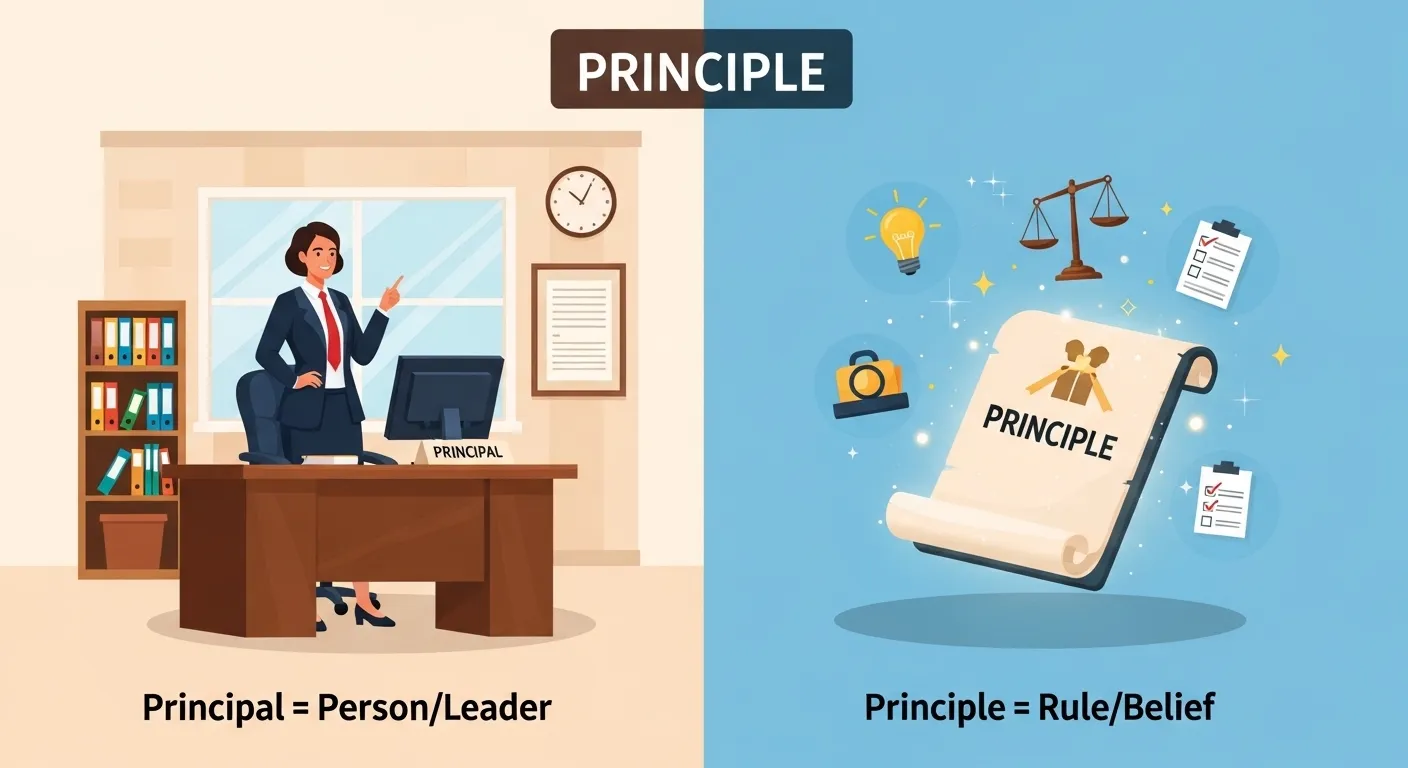
- Principal is usually a noun or adjective referring to someone in charge, a main amount, or something primary.
- Principle is always a noun, referring to a rule, belief, or fundamental truth.
Examples:
- The principal of the school welcomed all new students.
- She paid off the principal amount of her loan before interest.
- He always sticks to his principles, no matter the situation.
- The company operates on the principle of fairness and transparency.
The Origin of Principal or Principle
Both words come from the Latin root “principium”, meaning “beginning” or “foundation.” Over time, principal evolved in English to describe someone or something of primary importance, while principle came to mean a fundamental truth or belief. The spelling differences reflect these separate meanings, even though the pronunciation is nearly identical. This evolution is why native speakers sometimes confuse the two words in writing.
British English vs American English Spelling
Both principal and principle are spelled the same in British and American English. The difference lies in usage, not spelling.
| Word | British Usage | American Usage |
| Principal | School head, main amount | School head, main amount |
| Principle | Moral rule, fundamental truth | Moral rule, fundamental truth |
Which Spelling Should You Use?
- Use principal when referring to people in charge, main sums of money, or primary things.
- Use principle when discussing rules, ethics, or beliefs.
- If your audience is global, stick to these usage rules they are universally understood.
Common Mistakes with Principal or Principle
- Incorrect: He is a man of many principals.
Correct: He is a man of many principles. - Incorrect: The principle of the school introduced new policies.
Correct: The principal of the school introduced new policies. - Incorrect: She paid the principle early.
Correct: She paid the principal early.
Principal or Principle in Everyday Examples
- Emails: “Please contact the principal if you have concerns.”
- News: “The bank’s principal loan amount has decreased.”
- Social Media: “Stick to your principles, and success will follow.”
- Formal Writing: “Corporate governance should follow ethical principles.”
Principal or Principle – Google Trends & Usage Data
Data shows that searches for “principal or principle” spike during school admission periods and tax season (for loan principal questions). The United States and the United Kingdom lead in searches, highlighting common confusion in education and finance contexts.
Comparison Table: Principal vs Principle
| Feature | Principal | Principle |
| Part of Speech | Noun/Adjective | Noun |
| Meaning | Main person/thing, sum of money | Rule, belief, fundamental truth |
| Example 1 | School principal | Moral principle |
| Example 2 | Loan principal | Operating principle |
| Common Confusion | Mistaken for principle | Mistaken for principal |
FAQs
1. Can “principal” be used as an adjective?
Yes. Example: “The principal reason for his success is hard work.”
2. Is “principle” ever used as a verb?
No, it is always a noun.
3. How do I remember the difference?
Think: Principal = person or main thing, Principle = rule or belief.
4. Can both words be plural?
Yes. Principals (school heads), Principles (rules).
5. Are there other words that sound like these?
No exact homophones, but context is key to avoid confusion.
6. Which is more common in business writing?
Principal is common in finance; principle in ethics and strategy documents.
7. Does Google autocorrect one to the other?
Sometimes, but always double-check your meaning.
Conclusion:
Understanding the difference between principal and principle is essential for clear and professional writing.
While both words sound the same, their meanings are distinct. Principal refers to a primary person, amount, or thing, while principle represents a rule, belief, or fundamental truth.
By remembering these key distinctions, you can avoid embarrassing mistakes in emails, social media posts, and formal writing.
Always consider your audience and context: in finance, school, or professional communications, using the correct word reflects knowledge and credibility.
Regular practice and review of examples will help solidify these rules, ensuring that your English writing remains precise, professional, and easy to understand.

I am John Grisham, a bestselling author known for thrilling legal dramas that captivate millions. Discover more about my work at my site, Grammlyx.com.