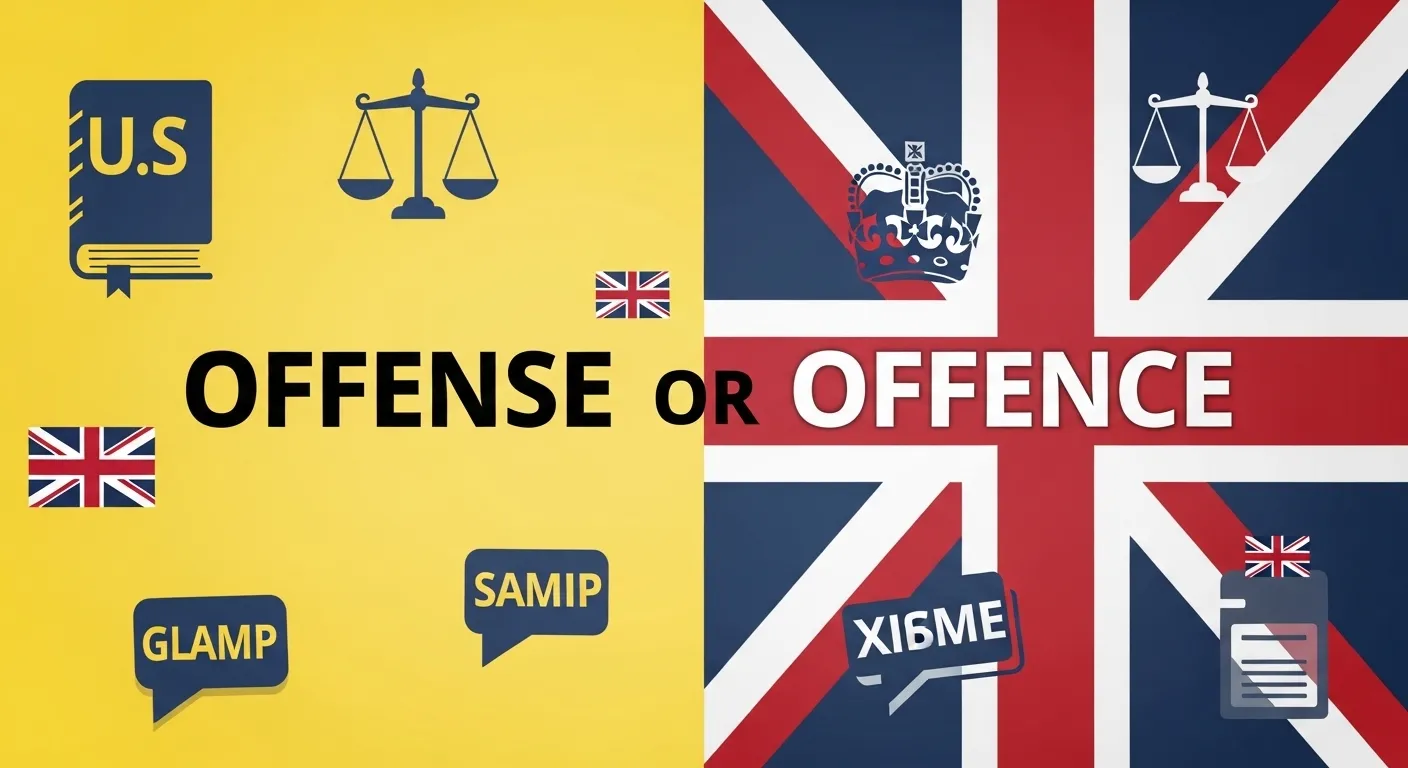
Do you ever get confused between offense and offence? You’re not alone. Many people search for this topic because English spelling varies across regions, and small differences can change the way your writing is perceived.
If you’re writing emails, articles, or social media posts, using the correct spelling is important.
This article will help you quickly understand the difference between offense and offence, show you which version is preferred in different countries, and give practical examples to avoid mistakes.
By the end, you’ll be confident in using the right word for any situation.
Offense or Offence – Quick Answer
Offense is the American English spelling.
Offence is the British English spelling.
Use offense if you are writing for a US audience. Use offence if your audience is British, Australian, Canadian, or from other Commonwealth countries.
Examples:
Example 1:
He took offense at the comment. (US English)
Example 2:
He took offence at the comment. (UK English)
The Origin of Offense or Offence
The word comes from the Old French offense, meaning “a cause of resentment” or “violation.” Both spellings were historically acceptable, but American English adopted the -ense form, while British English kept -ence. The difference is mostly regional rather than semantic the meaning remains the same.
British English vs American English Spelling
British and American English often differ in words ending with -ce/-se. The general rule is:
| Context | American English | British English |
| Legal & formal writing | offense | offence |
| Everyday writing | offense | offence |
| Sports (like football) | offense | offence |
Tip: If in doubt, check your audience’s location.
Which Spelling Should You Use?
- US Audience: Use offense.
- UK, Canada, Australia, Commonwealth: Use offence.
- Global / Mixed Audience: Choose one spelling consistently and stick to it.
Common Mistakes with Offense or Offence
- Mixing US and UK spellings in the same document.
- Using offence in American publications—may appear incorrect.
- Mispronouncing the word; both spellings are pronounced the same.
Correct Usage Tip: Pick the regional spelling and use it consistently throughout your text.
Offense or Offence in Everyday Examples
- Emails: “Please let me know if I caused any offense/offence.”
- News: “The politician’s statement caused public offense/offence.”
- Social Media: “No need to take offense/offence, it was a joke.”
- Formal Writing: “Acts of offense/offence will be punished under law.”
Offense or Offence – Google Trends & Usage Data
Search trends show offense is more common in the US, while offence dominates in the UK, Australia, and Canada. Globally, American English influence has made offense increasingly recognized, but local publications often prefer offence.
Keyword Variations Comparison Table
| Spelling | Region | Example Usage |
| Offense | US, international | He took offense easily. |
| Offence | UK, Commonwealth | He took offence easily. |
FAQs
1. Are offense and offence the same?
Yes, they mean the same thing. The difference is regional spelling.
2. Which is correct in legal documents?
Depends on the country: offense (US), offence (UK/Commonwealth).
3. Can I mix both spellings?
No, choose one spelling and use it consistently.
4. How do you pronounce offense/offence?
Both are pronounced the same: /əˈfens/.
5. Is offense used in sports?
Yes, especially in American sports: “The team’s offense scored first.”
6. Why is there a spelling difference?
American English simplified some -ence words to -ense in the 19th century.
7. Is one more formal than the other?
No, formality depends on context, not spelling.
Conclusion
In conclusion, understanding the subtle spelling differences between American and British English can help improve clarity in writing. Being aware of these variations ensures your communication is accurate and professional, whether for academic, work, or casual purposes. Paying attention to such details can make asignificant difference in how your message is perceived.

I am John Grisham, a bestselling author known for thrilling legal dramas that captivate millions. Discover more about my work at my site, Grammlyx.com.