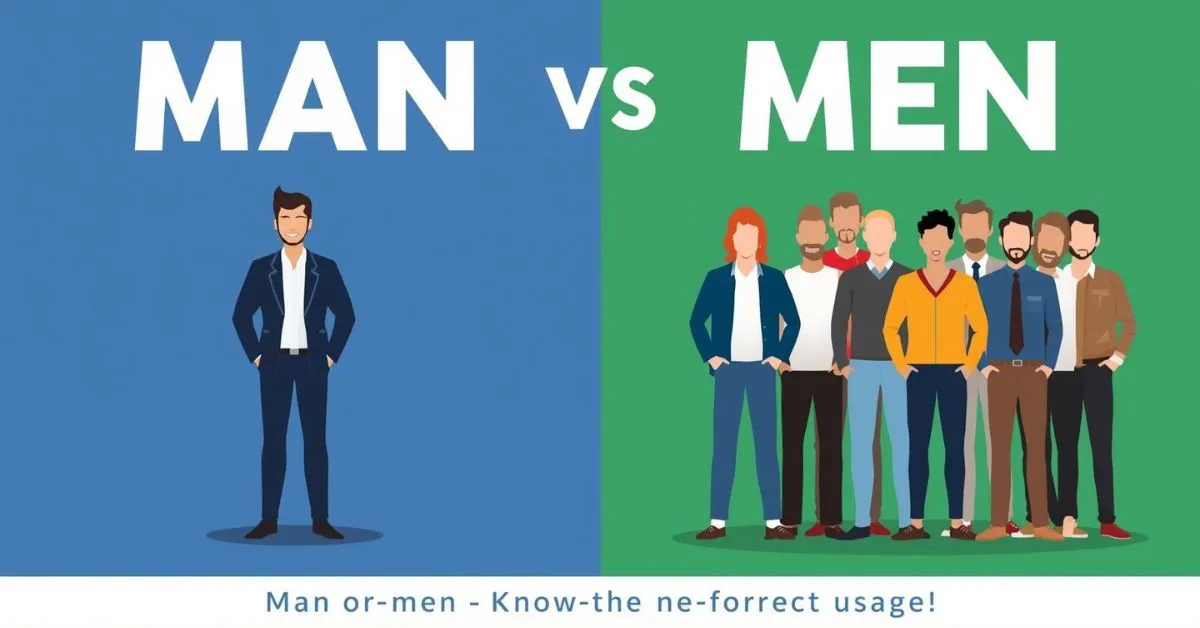
When it comes to English grammar, choosing between man and men can be tricky for many learners and writers.
People often search for this keyword because the difference is subtle but important: one is singular, and the other is plural.
Misusing these words can make sentences sound awkward or even change the meaning entirely. This confusion often arises in everyday writing, formal emails, social media posts, and even news articles.
Understanding when to use man versus men ensures your writing is accurate, professional, and easily understood by readers.
In this guide, we’ll break down the differences, explore origins, compare British and American usage, highlight common mistakes, and provide clear examples so you never get it wrong again.
Man or Men – Quick Answer
Quick Answer:
- Man = singular → refers to one adult male.
- Men = plural → refers to more than one adult male.
Examples:
- There is one man waiting outside.
- Three men are walking to the park.
The Origin of Man or Men
The word man originates from Old English mann, which originally referred to a human being regardless of gender. Over time, man became more specifically used for adult males. The plural form men comes from the Old English menn, which evolved from the same root but adapted to indicate more than one adult male. The shift in spelling from mann to men in the plural form is a feature of historical English vowel changes known as “i-mutation” or umlaut. Understanding this history explains why English plurals like “man → men” are irregular.
British English vs American English Spelling
In this case, both man and men are spelled the same way in British and American English. There are no regional spelling differences.
| Word | British English | American English | Usage Example |
| Man | Man | Man | A man is waiting at the bus stop. |
| Men | Men | Men | Five men are working in the office. |
Which Spelling Should You Use?
- US Audience: Use man for singular and men for plural.
- UK/Commonwealth Audience: Same rules apply; no difference in spelling.
- Global Writing: Stick to singular man for one male and men for multiple males to avoid confusion.
Common Mistakes with Man or Men
- Incorrect: I saw three man at the store.
Correct: I saw three men at the store. - Incorrect: That men is very tall.
Correct: That man is very tall. - Incorrect: The man are waiting for the bus.
Correct: The men are waiting for the bus.
Tip: Always check if you mean singular (man) or plural (men) before writing.
Man or Men in Everyday Examples
- Emails: “Dear Sir or Gentlemen” (formal)
- News Headlines: “Local Men Rescue Stranded Hiker”
- Social Media: “Three men just helped me carry groceries!”
- Formal Writing: “Each man is responsible for his own actions.”
Man or Men – Google Trends & Usage Data
- US: “Man” is searched slightly more often than “Men,” often due to singular-focused topics.
- UK: Similar trend, but plural references (sports teams, groups) spike “men” searches.
- Global: Both terms are commonly searched; context depends on singular vs plural focus.
Man or Men – Comparison Table
| Feature | Man | Men |
| Number | Singular | Plural |
| Refers to | One adult male | More than one adult male |
| Usage Example | The man is reading. | Five men are reading. |
FAQs
- Q: Is “man” ever used for females?
A: Historically yes, but modern English reserves man for adult males. - Q: Can “men” refer to mixed groups?
A: Typically, men is male-specific; “people” is preferred for mixed groups. - Q: What is the plural of “woman”?
A: Women (different spelling, pronounced /ˈwɪmɪn/). - Q: Are “man” and “men” pronounced differently?
A: Yes. Man rhymes with “can,” men rhymes with “pen.” - Q: Can I use “man” in idioms?
A: Absolutely, e.g., “a man of his word” or “every man for himself.” - Q: Is “men” ever singular?
A: No, men is always plural. - Q: Are there exceptions in spelling for other irregular plurals?
A: Yes, like foot → feet, child → children.
Conclusion
Understanding the difference between man and men is simple once you remember the singular versus plural rule. Man always refers to one adult male, while men refers to two or more. There are no regional spelling differences between British and American English, but proper usage ensures your writing remains professional and clear. Pay attention to context—emails, social media, and formal writing all require correct singular or plural forms. Regular practice, reading, and checking examples can make remembering the rules effortless. By mastering man vs men, you’ll communicate accurately, avoid common mistakes, and write with confidence in any English-speaking audience.

I am James Patterson, one of the world’s bestselling authors, known for fast-paced thrillers like the Alex Cross, Women’s Murder Club, and Maximum Ride series that have captivated millions of readers worldwide. I share my passion for storytelling and writing expertise with readers through my work and also feature insights on my site grammlyx.com, where great writing meets creativity.