When it comes to English spelling, small differences can create big confusion. One common question is “Leach or Leech?” People often wonder which spelling is correct and when to use each.
This confusion arises because both words exist in English but have very different meanings. Choosing the wrong word can change the meaning of a sentence completely.
Some may search for this keyword when writing essays, emails, or even reading online content. Others are curious about British vs American English spelling rules. Understanding the difference helps writers communicate clearly and avoid embarrassing mistakes.
In this article, we will give you a quick answer, explore the origin of the words, show everyday usage, compare British and American spelling, and provide practical tips. By the end, you will confidently know when to use “leach” and when “leech”.
Leach or Leech – Quick Answer
Quick Answer:
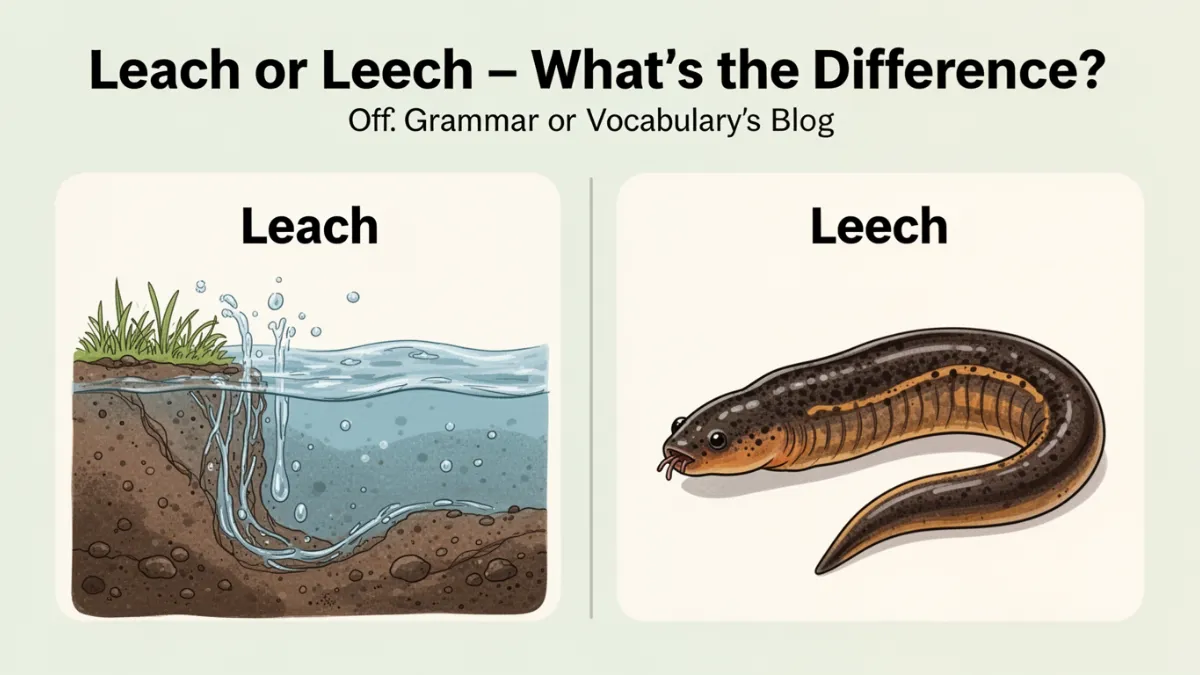
- Leach (verb) → means to drain or filter liquid through a substance.
- Leech (noun/verb) → refers to a blood-sucking creature or someone who exploits others.
Examples of Usage
Leach:
- Rainwater can leach nutrients from the soil.
- Chemicals may leach into the groundwater.
Leech:
- A leech attached itself to his leg while swimming in the lake.
- He felt like his colleague was trying to leech off his ideas.
The Origin of Leach and Leech
- Leach comes from Old English leccan, meaning “to wet or moisten,” often used in agriculture and chemistry.
- Leech originates from Old English lǣce, meaning “physician” or “bloodsucker.” Over time, it became associated with parasitic worms.
The different origins explain why the words look similar but serve different functions in modern English.
British English vs American English Spelling
| Word | British English | American English | Meaning |
| Leach | Leach | Leach | To drain, filter, or extract |
| Leech | Leech | Leech | Blood-sucking worm; exploiter |
Key Note: Both spellings are the same in the UK and US, but meaning is always context-dependent.
Which Spelling Should You Use?
- Use “Leach” if talking about liquids, soil, or chemical processes.
- Use “Leech” if referring to animals or metaphorically describing someone who takes advantage.
Audience tip: If your readers are global, focus on meaning rather than worrying about regional spelling.
Common Mistakes with Leach or Leech
- Using leech instead of leach in environmental writing.
- ❌ The fertilizer will leech into the soil.
- ✅ The fertilizer will leach into the soil.
- Confusing leach with the animal leech.
- ❌ He removed the leach from the patient.
- ✅ He removed the leech from the patient.
Leach or Leech in Everyday Examples
- Email: “Make sure the chemicals do not leach into the water supply.”
- News: “Swimmers were warned about leeches in the lake.”
- Social Media: “Don’t let him leech off your hard work!”
- Formal Writing: “Heavy rainfall may cause minerals to leach from the soil.”
Leach or Leech – Google Trends & Usage Data
- Leach is commonly searched in agriculture, chemistry, and environmental studies.
- Leech spikes in searches related to wildlife, health, and idiomatic expressions like “office leech.”
- Popular Countries:
- Leach → US, UK, Australia (academic/scientific content)
- Leech → India, UK, US (wildlife, informal usage)
Keyword Comparison Table
| Keyword | Meaning | Example Sentence |
| Leach | Drain/filter through | Nutrients may leach from the soil. |
| Leech | Bloodsucking worm/exploiter | The leech clung to his ankle in the lake. |
FAQs
1. Can I use leech for both meanings?
No, leech only refers to the animal or someone who exploits, not the filtering process.
2. Is leach only a verb?
Yes, leach is primarily used as a verb.
3. Are there any regional differences in usage?
No, both words are spelled the same in British and American English, but usage depends on meaning.
4. Can leech be a verb?
Yes, “to leech” means to exploit or drain resources from someone.
5. How do I remember the difference?
Think “leach = liquid” and “leech = living creature or person.”
6. Are there idioms with leech?
Yes, for example, “office leech” refers to someone taking advantage of colleagues’ work.
7. Can leach be used metaphorically?
Rarely, but mostly it is literal (soil, water, chemicals).
Conclusion
Understanding leach vs leech is crucial for clear writing. Leach relates to filtering or draining liquids, while leech refers to parasitic worms or metaphorical exploiters. Despite identical spelling in the UK and US, context defines the correct choice. Common mistakes happen when the words are swapped or misused, but remembering their meanings prevents errors.
For writers, scientists, or students, using the correct term improves clarity in emails, reports, and social media posts. Always focus on meaning: if your sentence talks about liquids, choose leach; if it involves an organism or someone taking advantage, choose leech. With this knowledge, you can confidently avoid confusion and write professionally in both British and American English contexts.

I am John Grisham, a bestselling author known for thrilling legal dramas that captivate millions. Discover more about my work at my site, Grammlyx.com.