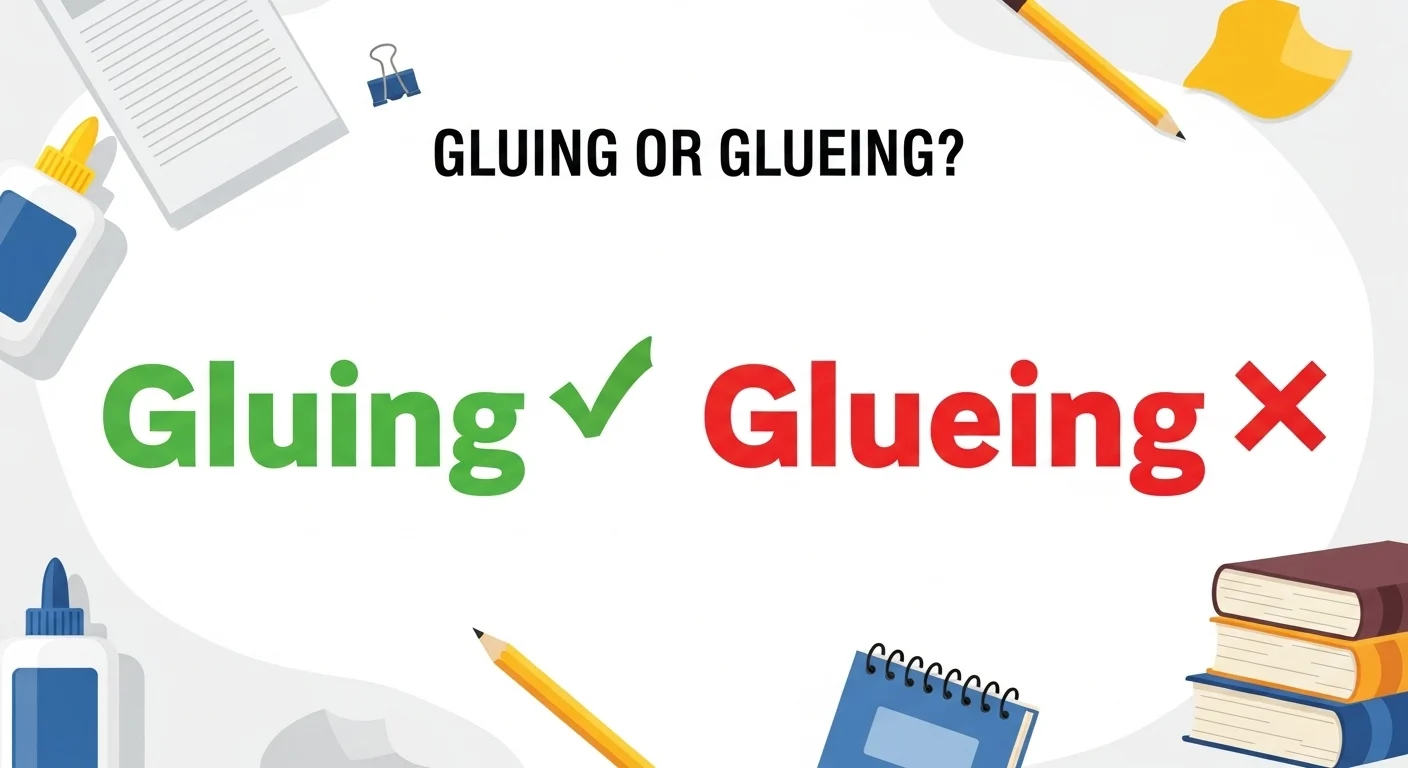
When people search for Gluing or Glueing, they want clarity. Many English speakers are unsure how to spell the continuous form of glue. Is it Gluing or Glueing? This confusion comes from English’s many spelling rules and exceptions.
Some learners rely on instinct and that does not always work. Others copy what they see online or in print, leading to more uncertainty. This article gives a clear, simple answer to help you write confidently.
If you are writing an email, homework, a blog post, or abusiness document, using the correct form matters. We’ll explain the rules, history, and real examples. You’ll understand why one spelling is much more common and when the other appears.
You’ll also see usage in everyday contexts and get tips toavoid mistakes. By the end, you’ll know which form to use confidently and why English has both!
Gluing or Glueing – Quick Answer
Gluing is the correct and standard form in modern English.
Glueing is an uncommon alternative that you might see sometimes, but it’s rarely used in formal writing.
Examples:
- I am Gluing the pieces of wood together for the project.
- She is Gluing the label onto the jar carefully.
Quick Answer:
In most cases, choose Gluing. Save Glueing only for niche or older texts where it might appear.
The Origin of Gluing or Glueing
The base word glue comes from Old French glu and Latin glū meaning sticky substance. Over time, English added -ing to verbs to form continuous tenses like running or jumping.
English has different ways to add -ing depending on the ending of the base word. Most words ending in a vowel + consonant — like glue — keep the e or drop it before adding -ing. With glue, dropping the e gives us gluing. Glueing comes from older spelling patterns where writers kept the e before -ing, but this never became standard.
British English vs American English Spelling
Most dictionaries and style guides in both British and American English use Gluing. Glueing might show up in informal texts, but it isn’t accepted as standard.
| Feature | Gluing | Glueing |
| British Standard | ✔️ | ⚠️ (rare) |
| American Standard | ✔️ | ⚠️ (rare) |
| Formal Writing | ✔️ | ❌ |
| Informal Use | ✔️ | ⚠️ |
Which Spelling Should You Use?
- US Audience: Always use Gluing. Americans stick with modern spellings.
- UK/Commonwealth Audience: Use Gluing too. British style guides prefer this form.
- Global or International Writing: Choose Gluing. It’s clear, simple, and widely accepted.
Using Gluing helps avoid confusion, especially for learners and readers of English as a second language.
Common Mistakes with Gluing or Glueing
People often make these errors:
- ❌ I am glueing the poster.
👉 Correct: I am Gluing the poster. - ❌ She is glueing papers together.
👉 Correct: She is Gluing papers together. - ❌ They were glueing stickers.
👉 Correct: They were Gluing stickers.
Remember: drop the e and add -ing.
Gluing or Glueing in Everyday Examples
Emails:
✔️ I’m Gluing the brochure pages now.
❌ I’m Glueing the brochure pages now.
News or Social Media:
✔️ Kids Gluing crafts at summer camp.
❌ Kids Glueing crafts at summer camp.
Formal Writing:
Always use Gluing for clarity and correctness.
Gluing or Glueing – Google Trends & Usage Data
Search engines and language databases show Gluing far more often than Glueing. Most English speakers, writers, and editors use Gluing. Glueing shows only tiny, occasional use, usually in informal writing or older texts. This confirms Gluing is the modern, preferred form in most countries and contexts.
Keyword Variations Comparison
| Variation | Correct? | Notes |
| Gluing | ✔️ | Standard and widely accepted |
| Glueing | ⚠️ | Rare and nonstandard |
| glue-ing | ❌ | Incorrect form |
| glue ing | ❌ | Incorrect form |
Frequently Asked Questions (FAQs)
1. Is Glueing a proper word?
It is a rare alternative but not considered standard in modern English.
2. Should I use Gluing in school essays?
Yes — always use Gluing for formal writing.
3. Is Gluing used in both American and British English?
Yes, it is the preferred form everywhere.
4. Does Glueing appear in dictionaries?
Some older dictionaries may list it as a variant, but it’s outdated.
5. Why not keep the e?
English typically drops the e when adding -ing after a vowel.
6. Is Gluing easy to remember?
Yes — drop the e from glue, then add -ing → Gluing.
7. Is there any context where Glueing is correct?
It may appear in some informal texts, but modern standards favor Gluing.
Conclusion
When choosing between Gluing or Glueing, go with Gluing. This spelling is standard in dictionaries, style guides, and most writing around the world. Glueing is rare and often seen only in informal or older texts. You’ll avoid mistakes by remembering the simple rule: drop the e before adding ing just like glue becomes Gluing. If you write emails, essays, or social media posts, Gluing is clear, correct, and widely recognized. Use it with confidence!

I am John Grisham, a bestselling author known for thrilling legal dramas that captivate millions. Discover more about my work at my site, Grammlyx.com.