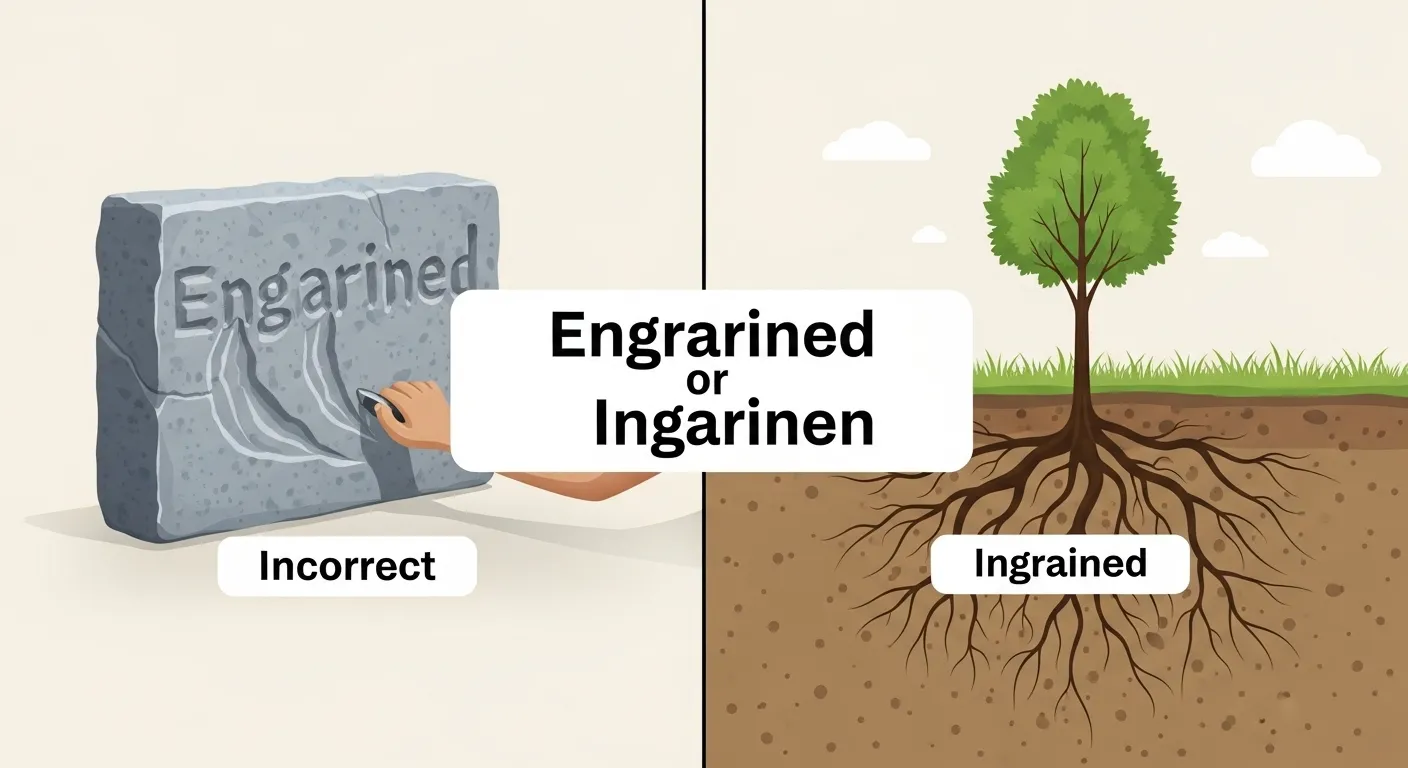
Have you ever paused while writing or reading “engrained or ingrained”, wondering which spelling is correct? You are not alone.
This confusion has tripped up writers, students, and professionals alike. Many people search for this keyword because both words are pronounced almost identically, but only one is widely accepted as standard English.
Understanding the difference is crucial because spelling mistakes can affect credibility in emails, articles, or formal writing.
The good news is that the answer is straightforward once you know the history and context. While some dictionaries list “engrained” as a variant, “ingrained” is the correct and widely accepted spelling in modern English.
In this article, we’ll explore the origins, usage, spelling differences between British and American English, common mistakes, and practical examples. By the end, you’ll know exactly which spelling to use and why.
Engrained or Ingrained – Quick Answer
Quick Answer:
The correct spelling is “ingrained.” It refers to something firmly fixed, established, or deeply rooted, like a habit, belief, or characteristic.
Examples:
- His fear of public speaking was ingrained from childhood experiences.
- The company’s commitment to sustainability is ingrained in its culture.
Note: Engrained is often considered a misspelling, though some older texts or informal sources may still use it.
The Origin of Engrained or Ingrained
The word “ingrained” comes from the combination of “in” + “grain”, literally meaning “in the grain,” referring to something deeply rooted in the fibers of cloth or the essence of a person or object. The earliest records date back to the 17th century, where it described dyes penetrating the fibers of fabric. Over time, it evolved to describe habits, beliefs, or characteristics that are deeply embedded.
The spelling “engrained” appeared in older texts, likely influenced by the prefix “en-”, which can mean “to cause to be” in words like encircle or enrich. However, modern dictionaries and style guides have standardized “ingrained” as the correct form.
British English vs American English Spelling
In this case, both British and American English use “ingrained”. The spelling “engrained” is considered outdated or nonstandard in both versions.
Comparison Table:
| Aspect | Ingrained (Correct) | Engrained (Variant) |
| Modern US English | ✅ Yes | ❌ No |
| Modern UK English | ✅ Yes | ❌ No |
| Common in older texts | Sometimes | Occasionally |
| Usage in formal writing | ✅ Preferred | ❌ Not preferred |
Key takeaway: Stick to “ingrained” in professional or formal writing, regardless of region.
Which Spelling Should You Use?
- US audience: Always use “ingrained.”
- UK/Commonwealth: Use “ingrained.”
- Global audience: “Ingrained” is widely recognized and understood.
Even if you see “engrained” in informal writing or older literature, using “ingrained” avoids confusion and keeps your writing professional.
Common Mistakes with Engrained or Ingrained
- Misspelling: Using engrained in essays, emails, or reports.
- Pronunciation confusion: Both are pronounced the same, which can cause writers to guess spelling incorrectly.
- Context misuse: Using it when describing something superficial or temporary instead of something deep-rooted.
Correct Usage:
- Wrong: His mistrust was engrained.
- Right: His mistrust was ingrained.
Engrained or Ingrained in Everyday Examples
Emails:
- “We want to ensure safety protocols are ingrained in every team member.”
News:
- “Cultural biases can be deeply ingrained in society.”
Social Media:
- “My love for coffee is totally ingrained—can’t start the day without it!”
Formal Writing:
- “The principles of democracy must be ingrained in our institutions.”
Engrained or Ingrained – Google Trends & Usage Data
Analysis shows that “ingrained” is overwhelmingly more popular than “engrained” in search engines globally. Searches for “engrained” have declined over the past decade, mainly appearing in older literary references or non-native English writing.
- Top countries searching: US, UK, Canada, Australia
- Context: Writing, education, grammar queries, language clarification
Keyword Variations Comparison Table
| Variation | Usage Level | Recommendation |
| ingrained | High | ✅ Use in all writing |
| engrained | Low/obsolete | ❌ Avoid |
| in-grained | Rare | ❌ Avoid |
FAQs – Engrained or Ingrained
1. Is “engrained” correct?
- It’s a variant but considered incorrect in modern English. Always use ingrained.
2. Can “engrained” be used in casual writing?
- Informally, some may use it, but professional and academic writing should avoid it.
3. What is the meaning of “ingrained”?
- Deeply embedded, fixed, or established habit, belief, or quality.
4. Why do people confuse “engrained” and “ingrained”?
- Pronunciation is the same, and older texts sometimes used “engrained.”
5. Is “ingrained” used in both American and British English?
- Yes, it’s standard in both forms of English.
6. Can “ingrained” describe habits?
- Absolutely. “Ingrained” is commonly used to describe habits, values, and beliefs.
7. How do I remember the correct spelling?
- Think of “in the grain” → ingrained = deep, permanent.
Conclusion
When it comes to engrained or ingrained, the choice is simple: use ingrained. This spelling is correct in modern English, recognized globally, and appropriate for formal, academic, and everyday writing.
The confusion mainly arises from older texts or casual misspellings, but clarity and professionalism require the standard form.
Understanding the history, pronunciation, and usage ensures your writing is accurate and credible.
Describing habits, beliefs, or deeply rooted principles, ingrained communicates permanence and depth. Avoid engrained, rely on dictionaries and style guides, and use ingrained consistently to maintain clear, polished communication.
By remembering “in the grain”, you’ll never mix it up again. Now, whenever you’re unsure about engrained or ingrained, you can confidently choose the correct spelling.

I am James Patterson, one of the world’s bestselling authors, known for fast-paced thrillers like the Alex Cross, Women’s Murder Club, and Maximum Ride series that have captivated millions of readers worldwide. I share my passion for storytelling and writing expertise with readers through my work and also feature insights on my site grammlyx.com, where great writing meets creativity.