Many people often wonder to write a dryer or dryer. Choosing the right spelling can be confusing because both words exist in English, but they serve slightly different purposes.
Knowing the correct usage not only improves your writing but also ensures you sound professional, whether in emails, social media, or formal documents.
This article will explain the difference between dryer and drier, their origins, usage rules, and practical examples to help you confidently use the right form every time.
People search for this keyword mainly because both words sound the same, but their meanings and contexts differ. Some assume “dryer” is always correct, while others use “drier” in casual writing.
Understanding the distinction clears this common confusion and ensures proper usage in both American and British English. By the end of this guide, you’ll know exactly which spelling fits your context.
Dryer or Drier – Quick Answer
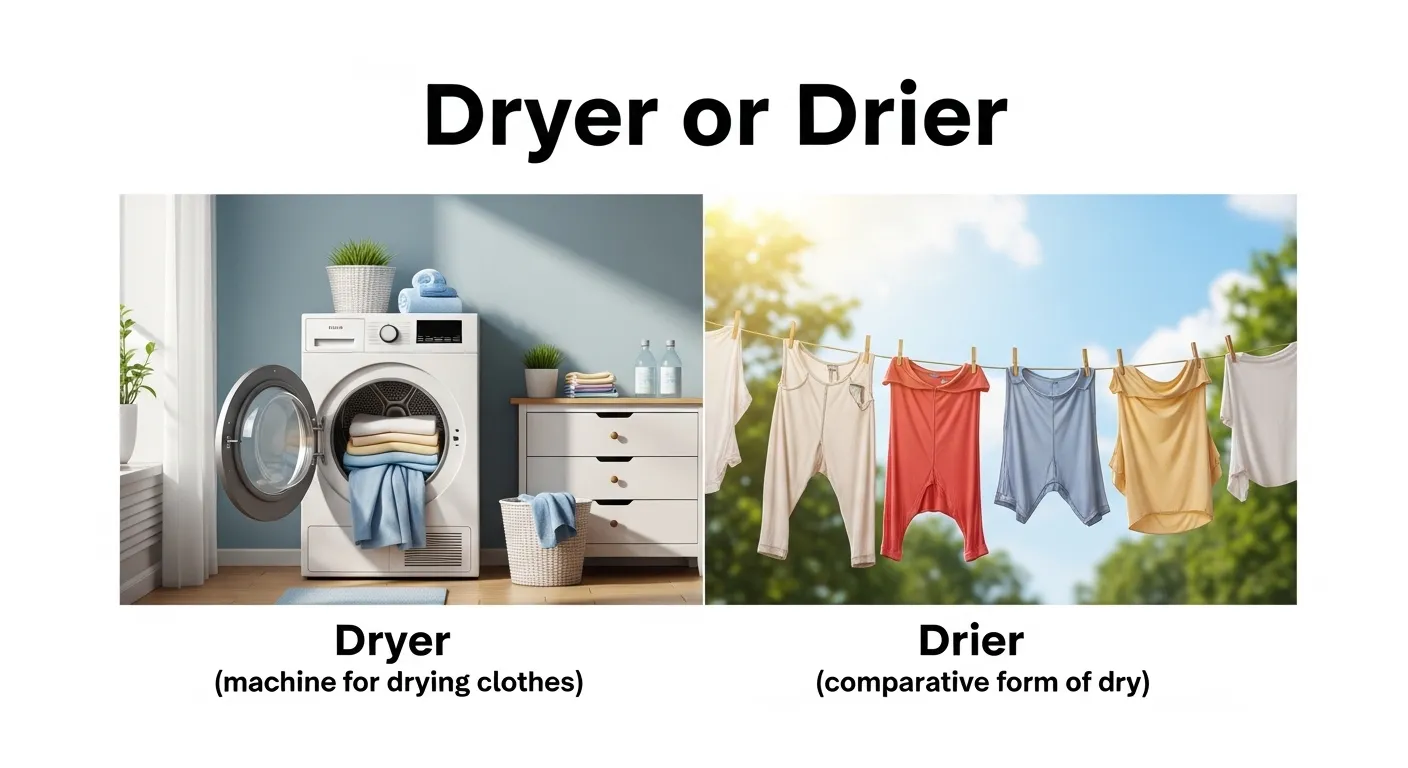
- Dryer: A noun referring to a machine or device that removes moisture.
- Example 1: I bought a new clothes dryer for my laundry room.
- Example 2: The hair dryer made her morning routine faster.
- Drier: An adjective meaning “more dry” when comparing things.
- Example 1: Today is drier than yesterday, so we can hang clothes outside.
- Example 2: The soil here is much drier than in the valley.
The Origin of Dryer or Drier
The words dryer and drier share the same root: the verb dry. English spelling evolved differently in various contexts:
- Dryer became the standard form for nouns describing machines or devices (from Middle English drien meaning “to remove moisture”).
- Drier followed the comparative adjective form (dry → drier → driest), a grammatical rule from Old English.
The distinction has existed for centuries, but confusion persists because pronunciation is identical. Over time, English dictionaries have recognized both forms, but context is key.
British English vs American English Spelling
Both British and American English use dryer and dryer, but preferences vary slightly.
| Word | Usage in UK English | Usage in US English |
| Dryer | Common for machines (laundry, hair) | Common for machines |
| Drier | More common for describing conditions (soil) | Also used for conditions |
Which Spelling Should You Use?
- US audience: Use dryer for machines and drier for describing dryness.
- UK/Commonwealth audience: Same rules apply; UK writers may lean more on drier in descriptive contexts.
- Global or professional writing: Follow context rules: noun = dryer, adjective = drier.
Tip: Always consider your audience and purpose. In technical writing, stick to the dryer for devices and the dryer for comparisons.
Common Mistakes with Dryer or Drier
- Incorrect: I need a new hair drier.
Correct: I need a new hair dryer. - Incorrect: Today is drier than yesterday.
Correct: Today is drier than yesterday. - Confusing both in casual writing: “The dryer clothes feel dryer” – correct as: “The dryer clothes feel drier.”
Dryer or Drier in Everyday Examples
- Emails: Please check if the clothes dryer is working.
- News: Farmers report a drier season than expected.
- Social media: My hair feels soft after using a new dryer!
- Formal writing: The region experienced a drier climate over the past decade.
Dryer or Drier – Google Trends & Usage Data
Data from Google Trends shows:
- Dryer is most searched in the US, Australia, and Canada, often in contexts related to appliances.
- Drier sees spikes in the UK and Europe, mostly related to agriculture, and climate discussions.
- Both keywords remain popular due to ongoing confusion over correct usage.
Comparison Table
| Form | Part of Speech | Usage Example |
| Dryer | Noun | I bought a new clothes dryer. |
| Drier | Adjective | The air today is drier than yesterday. |
FAQs
- Can I use “dryer” and “drier” interchangeably?
No. Dryer is for machines, drier is for comparisons. - Is “dryer” British or American?
Both, but more frequent in American English for devices. - Is “drier” used in American English?
Yes, for describing conditions like weather or soil. - Which one is correct in professional writing?
Follow context: noun = dryer, adjective = drier. - Can “drier” refer to a machine?
No, only descriptive situations. - Do dictionaries list both words?
Yes, with clear usage notes distinguishing noun and adjective forms. - What is the origin of “dryer”?
It comes from the verb dry, with “-er” as a noun-forming suffix for devices.
Conclusion
Choosing between dryer and drier is simple once you understand their roles. Use dryer when referring to machines that remove moisture, like a hair dryer or laundry dryer. Use drier to describe comparative dryness, such as “today is drier than yesterday.
British and American English both recognize these forms, but context guides proper usage. Confusion mainly arises from pronunciation and overlapping casual usage, so always consider whether you are describing a device or a condition.
By following these guidelines, your writing will be clear, professional, and grammatically correct. For emails, news, social media, or formal documents, the correct use of dryer and drier will enhance clarity and credibility. Understanding the subtle differences also helps non-native speakers and writers avoid common mistakes, making your communication more precise and effective.

I am James Patterson, one of the world’s bestselling authors, known for fast-paced thrillers like the Alex Cross, Women’s Murder Club, and Maximum Ride series that have captivated millions of readers worldwide. I share my passion for storytelling and writing expertise with readers through my work and also feature insights on my site grammlyx.com, where great writing meets creativity.