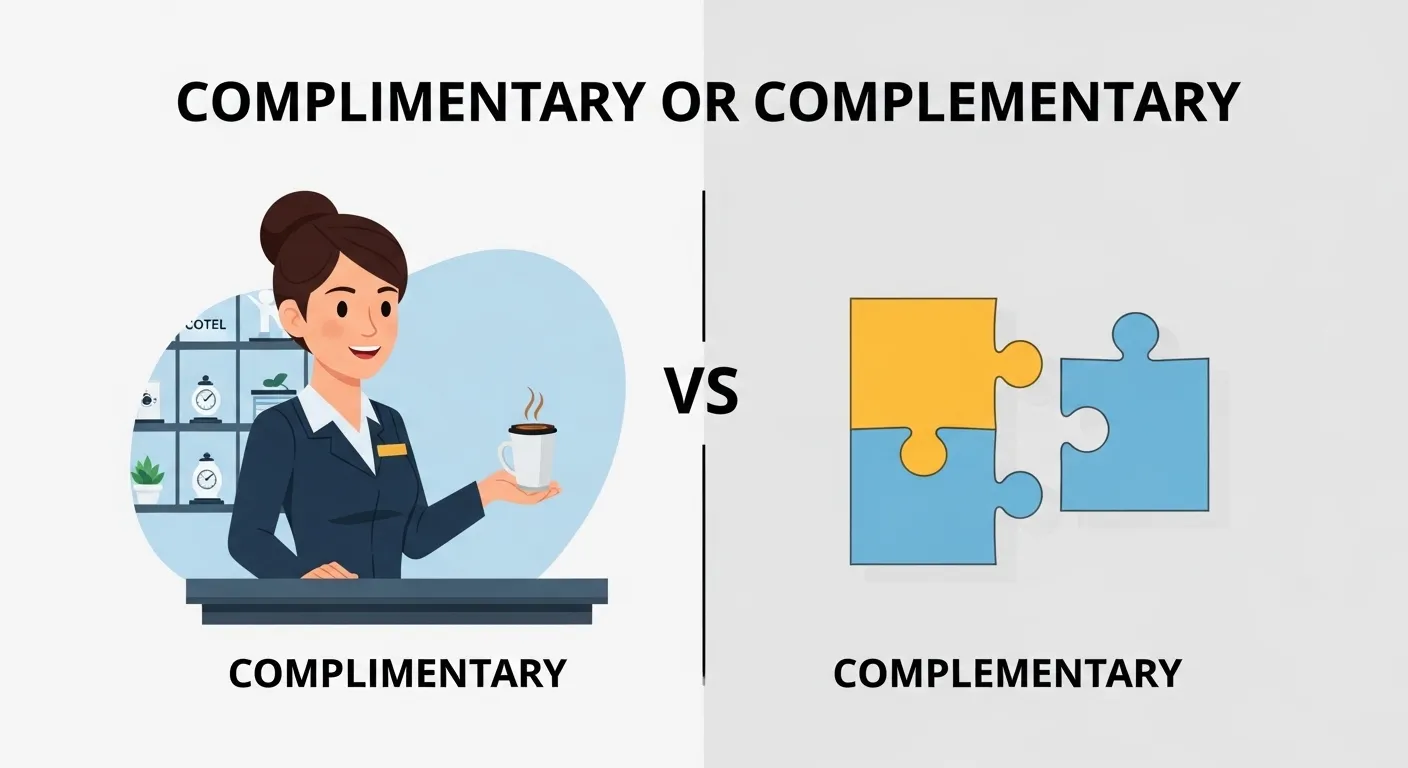
Many people get confused between “complimentary” and “complementary”. Both words sound the same, but they have different meanings and uses.
This confusion is common in writing emails, advertisements, and professional communication.
People often wonder: “Am I offering something free, or am I talking about things that go well together?” Understanding the difference can prevent miscommunication and make your writing appear more professional.
In this article, we’ll give you a clear answer, explain the origin, compare British and American spellings, show common mistakes, and provide examples for everyday use. By the end, you’ll confidently know which word to use in any situation.
Complimentary or Complementary – Quick Answer
Quick Answer:
- Complimentary – Means free of charge or praising someone.
- Complementary – Means something that completes or goes well with something else.
Examples:
- The hotel offers complimentary breakfast for all guests.
- Her scarf was complementary to her dress, matching perfectly in color.
The Origin of Complimentary or Complementary
- Complimentary comes from the Latin word complimentum, meaning expression of courtesy or praise.
- Complementary comes from the Latin word complementum, meaning something that completes.
The words evolved differently over time, which is why English now uses them in distinct contexts. The spelling difference reflects their separate roots and meanings.
British English vs American English Spelling
Both words are spelled the same in British and American English. The main difference lies in usage:
| Word | US Usage | UK Usage | Example |
| Complimentary | Common in both; often for free services | Common in both; also for praise | “The airline offers complimentary drinks.” |
| Complementary | Common in both; for matching or completing | Common in both | “The colors are complementary in design.” |
Which Spelling Should You Use?
- If writing for an American audience: Use complimentary for free items or praise; complementary for things that go together.
- If writing for a British/Commonwealth audience: Rules are the same as the US. Focus on context rather than spelling.
- Global content: Context is more important than region readers may understand the difference if examples are clear.
Common Mistakes with Complimentary or Complementary
- Using complimentary when you mean complementary.
- ❌ Incorrect: “These colors are complimentary.”
- ✅ Correct: “These colors are complementary.”
- Using complementary for free products or services.
- ❌ Incorrect: “Guests get complementary drinks.”
- ✅ Correct: “Guests get complimentary drinks.”
- Mixing both words in professional writing without understanding.
Complimentary or Complementary in Everyday Examples
- Emails: “We are pleased to offer you a complimentary service upgrade.”
- News articles: “The team’s skills are complementary, making them highly effective.”
- Social media: “Try these complementary colors in your design posts.”
- Formal writing: “Her remarks were complimentary, highlighting the achievements of the staff.”
Complimentary or Complementary – Google Trends & Usage Data
Data from Google Trends shows that:
- Complimentary spikes in searches related to hotels, restaurants, and free services.
- Complementary is mostly searched in design, fashion, education, and technology contexts.
- US users search complimentary more for free products.
- UK users use both terms similarly, depending on context.
Keyword Variations Comparison Table
| Keyword | Meaning | Example |
| Complimentary | Free or praising | “Enjoy complimentary coffee.” |
| Complementary | Completes or matches | “The wine is complementary to the meal.” |
Complimentary or Complementary
- Can complimentary mean both free and praising?
Yes, it can mean free of charge or giving praise depending on context. - Is complementary only for colors and design?
No, it can refer to anything that completes or enhances another thing. - Are these words interchangeable?
No, they have distinct meanings and cannot be swapped. - Which is more common in business writing?
Complimentary is often used for free services; complementary for teamwork or product design. - Do Brits and Americans spell them differently?
No, spelling is the same; meaning remains context-based. - Can I use compliments in social media posts?
Yes, when offering free items or expressing praise. - How do I remember the difference?
Think: Complimentary = free/praise, Complementary = completes/matches.
Conclusion:
Understanding the difference between complimentary and complementary is essential for clear communication. Complimentary refers to free items or praise, while complementary describes things that complete or enhance each other.
Using the wrong word can confuse readers, reduce professionalism, and affect credibility. By remembering their origins, context, and proper examples, you can easily master their usage in emails, social media, writing, or business communication.
Always check the context before writing it’s offering free services or describing items that match perfectly. With consistent practice, these words will become second nature, helping you write confidently and correctly.

I am James Patterson, one of the world’s bestselling authors, known for fast-paced thrillers like the Alex Cross, Women’s Murder Club, and Maximum Ride series that have captivated millions of readers worldwide. I share my passion for storytelling and writing expertise with readers through my work and also feature insights on my site grammlyx.com, where great writing meets creativity.