
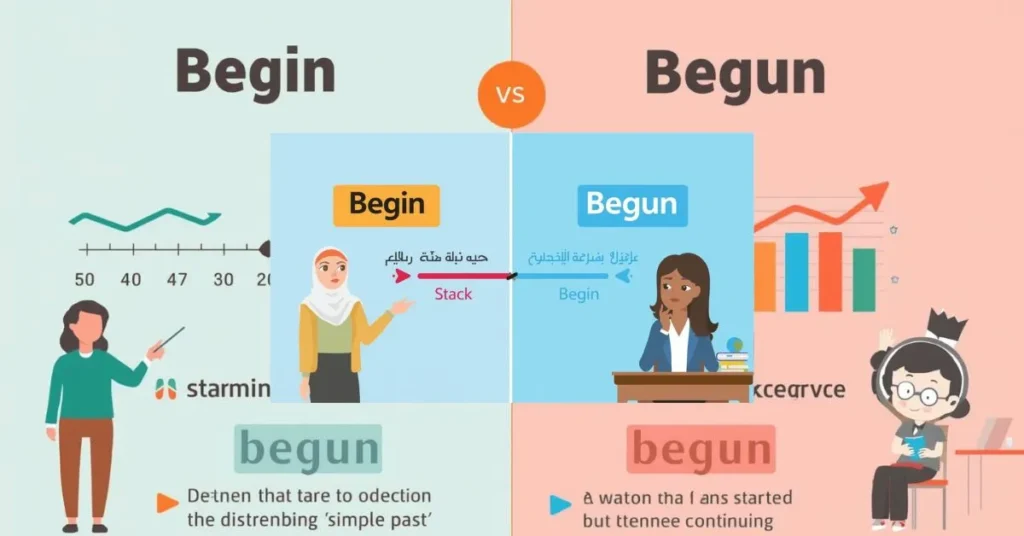
Confusing Begun and Began is one of the most common problems for English learners and even native speakers. Both words are forms of the verb “begin,” but they are used differently depending on tense and sentence structure.
Many people search for “begun or began” because they want to write correctly in emails, essays, social media posts, or professional documents. Choosing the wrong form can make writing seem unprofessional or grammatically incorrect.
Understanding the difference is simple once you know the rules. Began is the simple past tense, used when the action started in the past. Begun is the past participle, used with helping verbs like “have,” “has,” or “had.” For example, saying “I began my homework yesterday” is correct, while “I have begun my homework” is also correct.
This guide will clear up all confusion about begun or began. You’ll learn their origin, British vs. American usage, common mistakes, real-life examples, and expert advice on which form to use. Whether you’re writing a formal report, sending a casual email, or posting online, mastering this small detail will make your English more precise and confident.
Begun or Began – Quick Answer
Began → simple past tense (used alone).
Begun → past participle (used with “have,” “has,” “had”).
Examples:
- She Began learning piano last year.
- They have Begun their journey to the mountains.
The Origin of Begun or Began
Both began and begun come from the Old English verb “beginnan,” meaning “to start or initiate.” Over centuries, English developed different forms for past tense and past participle. This is why began and begun exist: one marks simple past events, the other shows completed actions with helping verbs.
British English vs American English Spelling
| Form | British English | American English | Example |
| Began | ✅ Used | ✅ Used | She began reading. |
| Begun | ✅ Used | ✅ Used | He has begun working. |
Note: There is no spelling difference between British and American English for these words; the difference lies in grammar usage.
Which Spelling Should You Use?
- US English: Use “began” for past tense and “begun” with helping verbs.
- UK/Commonwealth: Same rule applies.
- Global audiences: Follow standard grammar rules; it works universally.
Common Mistakes with Begun or Began
- ❌ I begun my homework yesterday → ✅ I began my homework yesterday.
- ❌ She has began the project → ✅ She has begun the project.
- ❌ They begun to run late → ✅ They began to run late.
Begun or Began in Everyday Examples
- Email: “I have begun reviewing your report.”
- News: “The city began new safety measures this week.”
- Social Media: “We’ve begun a new challenge!”
- Formal Writing: “The committee began discussions on climate policy.”
Begun or Began – Google Trends & Usage Data
Search data shows that confusion about begun or began spikes during academic seasons, especially in English learning forums. The term is most popular in the US, UK, India, and Canada, reflecting global interest in correct grammar usage.
Keyword Variations Comparison Table
| Keyword | Usage Type | Example |
| Began | Simple Past | She began the project yesterday. |
| Begun | Past Participle | They have begun construction. |
FAQs
- Can I use begun without “have/has/had”?
❌ No, “begun” always needs a helping verb. - Is began or begun correct after “yesterday”?
✅ “Began” is correct because it refers to past time. - Can both words be used interchangeably?
❌ No, using them incorrectly changes the tense. - Which is more formal, began or begun?
Both are formal; correctness depends on context. - Is “I have began” correct?
❌ No, the correct form is “I have begun.” - Do British and American English differ for these words?
✅ No, usage rules are the same. - Can I use “begun” in a question?
✅ Yes, e.g., “Have you begun your work?”
Conclusion
Mastering begun or began is essential for clear and professional English writing. The distinction is straightforward: began is the simple past, while begun is the past participle used with helping verbs. Many learners and writers search for this topic because misusing these words can make sentences grammatically incorrect, confusing readers or colleagues.
By understanding the origin of these words and their consistent usage in British and American English, you can confidently choose the right form for any situation. Common mistakes often occur when “begun” is used without a helping verb or “began” is used with “have/has/had.” Observing examples in emails, news articles, and social media can reinforce proper usage.
Remember, the key is context: if the action is simple past, use began. If it is part of a completed action or ongoing process with a helping verb, use begun. With this simple rule, your writing will appear polished, professional, and grammatically correct. Following these tips ensures your communication—whether formal, academic, or casual—is always accurate and effective.

I am James Patterson, one of the world’s bestselling authors, known for fast-paced thrillers like the Alex Cross, Women’s Murder Club, and Maximum Ride series that have captivated millions of readers worldwide. I share my passion for storytelling and writing expertise with readers through my work and also feature insights on my site grammlyx.com, where great writing meets creativity.