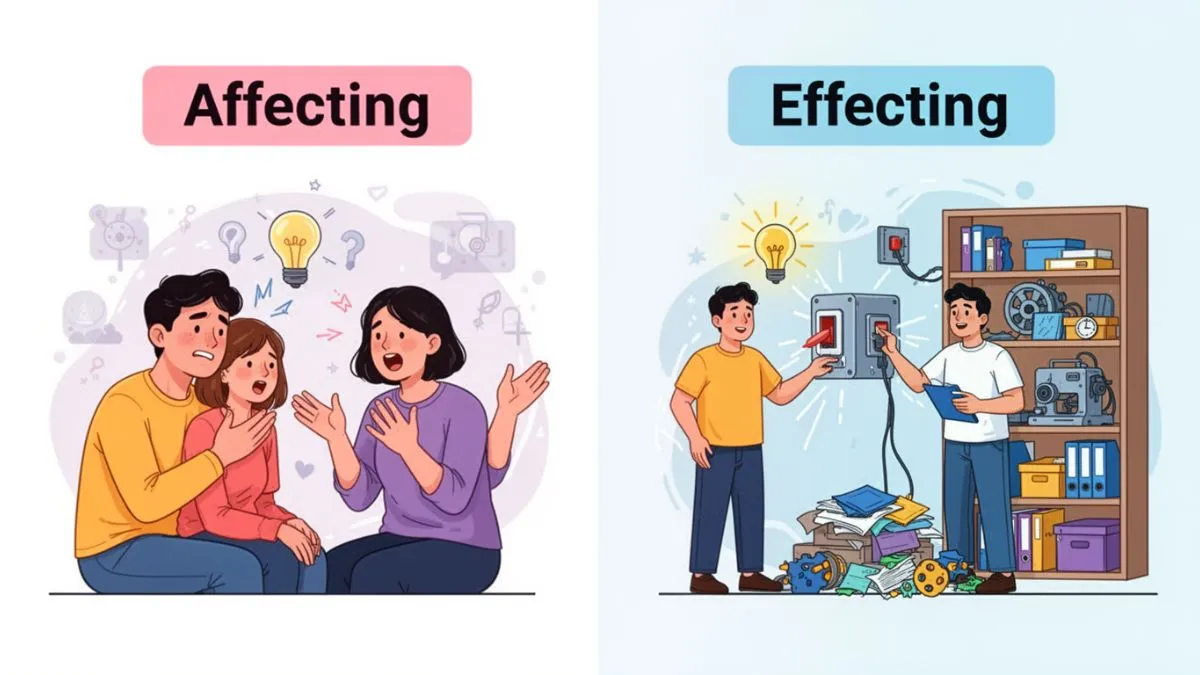
Choosing between affecting or effecting can be confusing. Many writers, students, and professionals struggle to decide which word fits in a sentence.
Both words sound similar but have very different meanings and uses. Understanding the difference helps you communicate clearly and avoid embarrassing mistakes in emails, reports, or social media posts.
In this guide, we will break down the meanings, origins, spelling differences, common mistakes, and practical examples of affecting and effecting.
If you are a native speaker, learning English, or writing for a global audience, this article will give you clear rules and tips for using the right word every time. By the end, you’ll know exactly when to use each and why it matters.
Affecting or Effecting – Quick Answer
- Affecting is usually a verb meaning to influence or change something.
- Effecting is usually a verb meaning to bring about or cause something to happen.
Examples:
- The heavy rain is affecting the crops in the region.
- The new manager is effecting major changes in the office policies.
The Origin of Affecting or Effecting
- Affecting comes from the Latin afficere, meaning to influence or act upon. It has been used in English since the 14th century.
- Effecting comes from the Latin efficere, meaning to bring about or accomplish. It appeared in English around the 16th century.
The similarity in pronunciation leads to confusion, but the roots show their distinct purposes: one changes things (affecting), the other creates results (effecting).
British English vs American English Spelling
Both words are spelled the same in British and American English. However, usage can differ slightly:
| Word | Meaning (UK) | Meaning (US) | Example (UK) | Example (US) |
| Affecting | Influencing | Influencing | Poor weather is affecting travel. | Poor weather is affecting travel. |
| Effecting | Bringing about | Bringing about | He is effecting policy changes. | He is effecting policy changes. |
Key Tip: No spelling change is needed between UK and US English; just be mindful of context.
Which Spelling Should You Use?
- Use affecting when talking about influence or emotional impact.
- Use effecting when talking about creating or causing change.
Audience Advice:
- US and UK writers follow the same spelling rules.
- For international writing, focus on meaning rather than regional preference.
Common Mistakes with Affecting or Effecting
- Using effecting instead of affecting when describing emotions:
- ❌ The movie was effecting.
- ✅ The movie was affecting.
- Using affecting instead of effecting when describing actions:
- ❌ She is affecting new regulations.
- ✅ She is effecting new regulations.
- Confusing noun effect with verb effecting:
- ❌ The effecting of change took time.
- ✅ The effect of the change was immediate.
Affecting or Effecting in Everyday Examples
- Emails: “The recent update is affecting user access.”
- News articles: “The CEO is effecting major corporate reforms.”
- Social media posts: “The charity campaign is truly affecting lives worldwide.”
- Formal writing: “The board is effecting policy amendments to improve compliance.”
Affecting or Effecting – Google Trends & Usage Data
- Affecting is searched more frequently globally than effecting, because influence is more common in everyday context.
- Effecting appears more in professional, legal, or policy-related contexts.
- Countries like the US, UK, Canada, and Australia show similar usage trends, with affecting dominating casual searches.
Keyword Variations Comparison Table
| Variation | Usage Tip |
| Affecting | Use for influence, change, or emotional impact. |
| Effecting | Use for causing, creating, or bringing about. |
| Affect | Noun or verb, often about influence. |
| Effect | Noun, result or outcome of a change. |
FAQs
- Is affecting or effecting a noun?
- Affecting is always a verb; effecting is a verb too. The noun forms are affect and effect.
- Can I use affecting in formal writing?
- Yes, when describing influence, impact, or change.
- When should I use effecting in a sentence?
- Use it when you are describing the act of causing or implementing something.
- Do Americans and Brits spell these words differently?
- No, both US and UK English use the same spelling.
- Why do people confuse these words?
- Similar pronunciation and related meanings create common mistakes.
- Is “affecting change” correct?
- ❌ Usually incorrect; ✅ Use effecting change when implementing.
- Can affect be replaced with effect?
- Not always; “affect” is about influence, “effect” is about result.
Conclusion
Understanding affecting or effecting is essential for clear communication. Remember: affecting influences or changes something, while effecting actively brings about a result.
Paying attention to context, such as emotional impact versus action creation, will prevent mistakes in writing, emails, social media, and professional documents.
While both words share Latin origins and similar sounds, their purposes differ greatly. Always double-check your sentence to ensure the intended meaning is clear.
For global audiences, focus on correct usage rather than regional spelling, and remember that clarity in writing builds trust, professionalism, and understanding.
By mastering these distinctions, you will never confuse affecting or effecting again, improving both your writing and your reader’s comprehension.

I am John Grisham, a bestselling author known for thrilling legal dramas that captivate millions. Discover more about my work at my site, Grammlyx.com.