
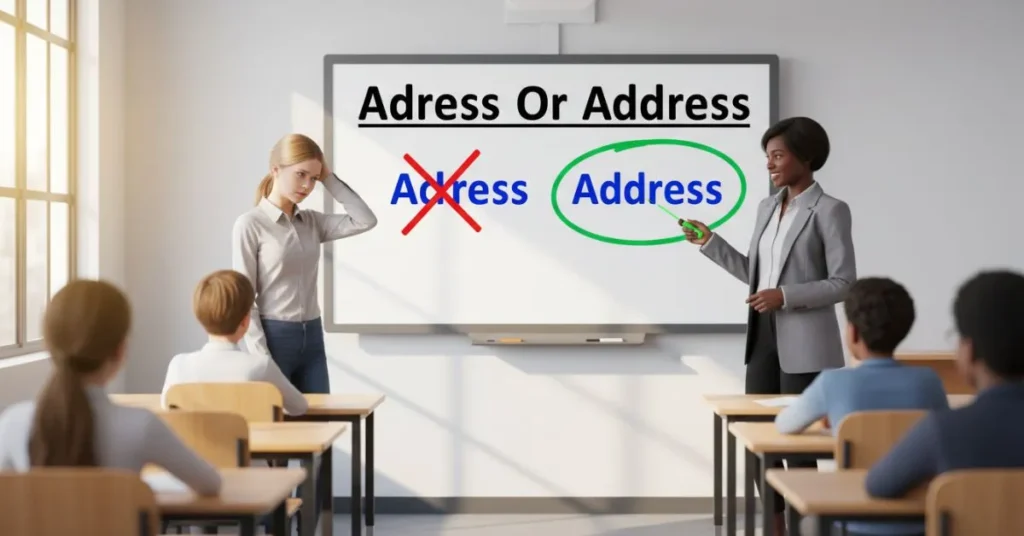
You type a location, an email, or a home detail… and pause. Is it Adress Or Address? This tiny spelling doubt is very common. Many people search for this keyword because both words look right at first glance. But only one spelling is correct in standard English.
This confusion happens because English has double letters that don’t always follow simple rules. Words like “across,” “success,” and “address” use double consonants, and people often forget one letter. A small typo can cause big problems — emails may not be sent, forms may be rejected, and writing may look unprofessional.
This article gives a quick answer first, then explains everything in simple words. You’ll learn the history of Adress Or Address, British and American usage, common mistakes, real-life examples, and expert advice on which spelling to use. Let’s clear the confusion once and for all.
Adress Or Address – Quick Answer
The correct spelling is Address with double D. Adress is a spelling mistake and not a real English word.
Examples:
I wrote my home Address on the form.
Please check the email Address before sending.
The Origin of Adress Or Address
The word Address comes from Old French adresser, meaning “to direct” or “to guide.” It later entered Middle English and kept the double D sound. Over time, the spelling stayed the same in standard English.
The wrong form Adress appeared because people often drop one letter when spelling fast. But dictionaries only recognize Address as correct.
British English vs American English Spelling
Good news: there is no difference between British and American English for Adress Or Address. Both use Address.
| Version | Correct Spelling | Example |
| British English | Address | Write your Address clearly. |
| American English | Address | Enter your email Address. |
Which Spelling Should You Use?
Always use Address.
- US audience → Address
- UK/Commonwealth → Address
- Global writing → Address
Using Adress can make your writing look careless.
Common Mistakes with Adress Or Address
| Mistake | Correction |
| Adress | Address |
| Email Adress | Email Address |
| Home Adress | Home Address |
Adress Or Address in Everyday Examples
Email: Please confirm your email Address.
News: The mayor changed his home Address.
Social Media: DM me your Address.
Formal Writing: Kindly update your postal Address.
Adress Or Address – Google Trends & Usage Data
Search data shows people often type Adress by mistake, especially students and non-native speakers. But official writing, books, and media always use Address. Countries with strong English education show higher correct usage.
Comparison Table
| Word Form | Correct? | Meaning |
| Adress | ❌ No | Spelling error |
| Address | ✅ Yes | Location, speech, or contact info |
FAQs
1. Is Adress ever correct?
No. It is always wrong.
2. Why does Address have double D?
Because of its French origin.
3. Is there a US vs UK difference?
No difference.
4. What does Address mean?
It means location, speech, or contact detail.
5. Why do people write Adress?
Typing fast or not knowing spelling rules.
6. Is Address used as a verb?
Yes. Example: “She will Address the crowd.”
7. Does spell-check fix Adress?
Yes, most tools correct it.
Conclusion
The confusion between Adress Or Address is simple but important. Only Address is correct. The mistake happens because English spelling has double letters that people forget. Both British and American English use the same spelling, so there is no regional change to worry about.
Using the right spelling matters in emails, job forms, school work, and official documents. A small error can make writing look unprofessional or cause real communication problems. The safest rule is easy: if you mean location, contact detail, or speaking to someone, always write Address.
Now you know the history, rules, and usage. Next time you type it, you won’t hesitate.

I am John Grisham, a bestselling author known for thrilling legal dramas that captivate millions. Discover more about my work at my site, Grammlyx.com.